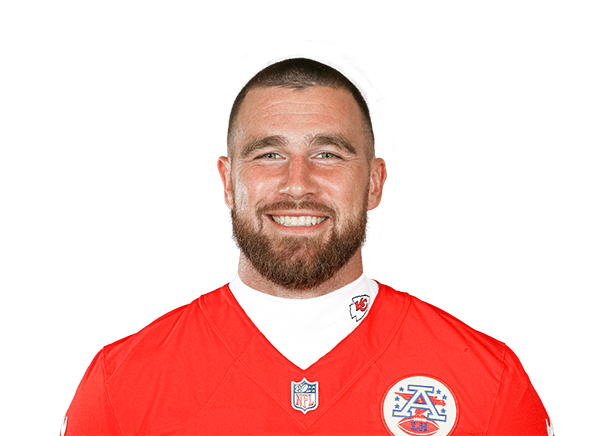
The case for drafting Travis Kelce in 2026 is not hard to make, and it deserves to be stated plainly before it gets picked apart. He is still Kansas City's primary tight end. He is still catching passes from Patrick Mahomes, the same quarterback who made him the most productive tight end of his generation. He finished 2025 with 76 receptions, 851 yards, and 5 touchdowns, numbers that would satisfy most fantasy managers at the position even in a down year. One September ranking piece captured the prevailing mood directly: "He may not have the ceiling that he provided earlier in his career, but it looks like the veteran still has enough in the tank to bring great value at his current ADP."
That is a reasonable position. Kelce is not being drafted as a top-five tight end this year, and treating him like a straw-man overpay would misrepresent the market. But the market is not uniform either, and the gap between where different sources price him says something important on its own.
What the Chiefs Offense Around Kelce Actually Looks Like Now
Patrick Mahomes remains the starting quarterback, so the passing volume that has always fed Kelce is not disappearing wholesale. But two other pieces of the offense matter more than they get credit for. Rashee Rice sits atop the Chiefs' receiver depth chart, and Kenneth Walker III is the lead back. Both are legitimate claims on the ball in an offense that only has so many targets and touches to distribute. Neither player is new competition for Kelce's specific role, but both represent volume that is not funneling through the tight end position, and that matters when the question is whether Kelce's target share holds at its old level or keeps eroding toward the middle of the position.
The bigger change is at play-caller. Eric Bieniemy was rehired as Kansas City's offensive coordinator in January 2026, replacing Matt Nagy. A coordinator swap is not the same as a new weapon walking into the tight end room, and nothing in the offseason record confirms a direct target competitor added to challenge Kelce for his snaps. But a new play-caller changes how targets get distributed inside an existing group, and that uncertainty lands squarely on the one player whose fantasy value depends on staying the focal point rather than becoming one option among several.
The Numbers Are Already Pointing Down, Not Sideways
Start with what actually happened. Kelce's 2025 season, 76 catches, 851 yards, 5 touchdowns, is solid but not commanding. Now look at where the projection models put him for 2026. One system has him at 103 targets, 74 catches, 770 yards, and 4 touchdowns, good for a TE9 finish. A separate projection puts him at 141 total points and a TE12 rank. Neither of those numbers is a collapse. Both are a continuation of the same trend line: fewer yards, fewer touchdowns, a target total that sounds stable in isolation but produces a lower per-target payoff than the version of Kelce that made him a first-round tight end in his prime. Projecting a TE9 or TE12 finish is not projecting a bust in the traditional sense. It is projecting exactly the kind of quiet decline that burns managers who draft him expecting the older numbers to reappear.
Why the ADP Itself Is the Tell
Here is the detail that should worry anyone holding Kelce shares more than the raw stat line. The market cannot agree on what he is worth. One source has his average pick at 102.9 overall. Another has him at 99.8. A third consensus snapshot from early September put him at 136 overall, a meaningfully cheaper cost than either of the first two. Positional rankings scattered him between TE10 and TE11 depending on the format. A riser-faller note from the same week showed his ADP down 4.2 spots over the prior seven days.
That is not the signature of a settled, well-understood asset. It is the signature of a player the market is actively repricing in real time, and the direction of that repricing has been down, not up. When three reputable snapshots taken within roughly a week of each other disagree by more than 30 picks on where a player belongs, the honest read is that nobody has full confidence in the role, and confidence gaps like that tend to resolve toward the more conservative number once the season starts, not the more generous one.
What Would Still Have to Break Kelce's Way
The fade case is not a lock, and it is worth being honest about what could make it wrong. Mahomes could simply keep targeting Kelce at his old rate regardless of who is calling plays, treating him as the trusted safety valve he has always been in big moments. If that happens, a TE9-to-TE12 range projection is actually a floor, not a ceiling, and Kelce could push back into the fringes of the top ten purely on target retention even with modest efficiency. That is the scenario the more optimistic ranking piece is implicitly betting on when it says he still has "enough in the tank." The counter to that counter is simple: the same article conceded the ceiling is gone, and a player without a ceiling who also faces new uncertainty at play-caller is not a player worth paying starter-plus cost for on draft day.
The Verdict on Kelce's Price Tag
Put it together and the strict version of the original worry, that Kelce is being drafted top-five at tight end, does not hold up against the actual market data, which mostly clusters him at TE10 to TE12 already. But the spirit of the concern holds. Even at that discounted price, Kelce is being paid for stability he no longer clearly has: a new offensive coordinator, a receiving corps and backfield that already have their own focal points in Rashee Rice and Kenneth Walker III, and a projection profile that has him drifting toward the back half of startable tight ends rather than the front. The right move is not to avoid him entirely, it is to stop paying even TE10 cost for him. Let him fall to the range the ADP volatility already suggests he deserves, and treat any finish inside the top ten as a pleasant surprise rather than the baseline expectation.