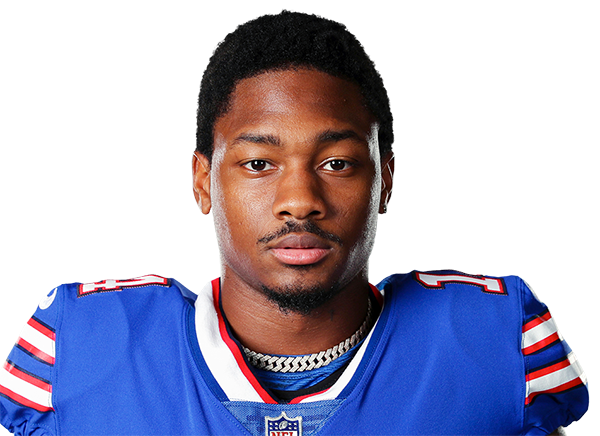
Terry McLaurin suffered a season-ending torn patellar tendon in late October, and that single event is the entire reason Stefon Diggs is worth discussing this week. Diggs signed with Washington on a one-year deal in August after a 2025 season with New England, and he opened 2026 as the clear No. 2 receiver behind McLaurin. With McLaurin now out for the year, Diggs is the most experienced, highest-volume receiver left on Washington's roster. That part of the story is straightforward.
What is not straightforward is how much actually changes in his week-to-week role. Head coach Dan Quinn reportedly said Diggs' workload would not change much even after McLaurin went down. That is a direct signal from the building that the post-McLaurin bump some fantasy managers are pricing in may be smaller than the depth chart shift implies. The case for Diggs has to be built on what his usage already is, not on an assumed spike that the coaching staff has publicly downplayed.
What Diggs Was In New England, And Why It Doesn't Transfer
In 2025 with New England, Diggs caught 85 of 102 targets for 1,013 yards and four touchdowns across 17 games, finishing as WR17 with 210.3 PPR points. That is a solid but unspectacular result, and it was produced in a different offense, with a different quarterback, under a different play-caller. None of those conditions carried over. Diggs is now catching passes from Jayden Daniels in Washington, not throwing hands with whoever lined up under center in New England, and Washington fired offensive coordinator Kliff Kingsbury after last season, promoting David Blough to replace him. A receiver's target share and catch rate are functions of the system he plays in as much as his own skill, and Diggs changed every variable in that equation this offseason.
The 2026 numbers reflect a player still searching for rhythm in a new context. Through six games, Diggs has 44 targets, 27 catches, 252 yards, and five touchdowns, good for 42.0 yards per game. He ranks 22nd in fantasy points per game and 21st in targets per game among qualified receivers, but 12th in targets per route run, which suggests his route participation is more efficient than his raw counting stats show. The touchdowns are propping up an otherwise modest yardage total. That is not a drought in the scoring column, but it is a drought in the yardage column, and the two things do not move in lockstep forever.
The Receiver Room Washington Built Around Him
McLaurin's absence is the headline, but he is not the only name that matters in this room. Washington re-signed Treylon Burks in the offseason and drafted Antonio Williams, and both compete for complementary receiver snaps, though the initial depth chart placed Burks behind McLaurin rather than directly behind Diggs. Dyami Brown and Luke McCaffrey round out the complementary pieces. None of them profile as a threat to Diggs' target share the way McLaurin's return would have been; they are rotational pieces, not a second alpha receiver. That is a meaningful structural point in Diggs' favor — with McLaurin gone, there is no obvious internal competitor for the No. 1 role, even if Quinn's comments suggest the staff isn't planning to simply redirect McLaurin's old targets wholesale.
Jayden Daniels remains the starting quarterback, which matters because it means the passing offense's decision-maker has not changed, only the coordinator calling the plays has. Blough's relationship with Daniels was cited as a reason for his promotion, which at minimum suggests continuity in how the quarterback is used rather than a scheme overhaul. Diggs now operates as the clear veteran option in a passing game run by a first-time coordinator and a quarterback who, by the dossier's own framing, the staff wanted paired with someone he already trusted. That is a reasonable floor-raising detail, but it is not evidence of an imminent target explosion.
The Case Against a Top-12 Jump, Steelmanned
The strongest objection to buying Diggs now is built on exactly the comments and numbers already cited. Quinn said the workload wouldn't change much. Diggs is averaging only 42.0 yards per game despite 7.3 targets per game and a 23% target share, which means the yards have to come from somewhere for a real leap to materialize, and nothing in the dossier identifies where that comes from beyond hoping touchdown luck continues. He is 32 years old, missed one game already with a hamstring injury, and carried hand and hamstring designations into a Philadelphia game in early November before playing. His 61% snap share leaves real room for a committee approach if Washington trusts Burks or Williams more as the season wears on. And his 2025 season, even at a healthier target volume with New England, topped out at WR17, not top 12. Stacking all of that together, the honest baseline projection is a top-15 finish if the current usage holds, not a top-12 breakout.
The answer to that case is not to dismiss it but to separate what has actually happened from what has merely not happened yet. Diggs has scored five touchdowns in six games and received at least six targets in every game he has played this season. A receiver who is seeing consistent high-value volume and converting it into touchdowns is not in a scoring drought in the sense the term usually implies; he is in a yardage lull inside an otherwise functional role. McLaurin's absence removes the only player in the building who was unambiguously ahead of Diggs on the depth chart, and even a modest increase in red-zone or intermediate-route usage, layered onto a target share that is already above average, moves the needle more than the touchdown total alone suggests.
The Call on Diggs
The fair read here is not the aggressive top-12 outcome in the original framing, and it is also not a dismissal. Diggs is Washington's de facto lead receiver by default, playing a substantial, touchdown-productive role for a quarterback who has not changed and a coordinator who was chosen in part for continuity with that quarterback. The realistic ceiling, grounded in the targets-per-route-run data and the lack of a clear internal competitor since McLaurin's injury, is a high-end WR3 who flashes WR2 weeks when the touchdowns hit. Treat Diggs as a buy-low add in point-per-reception formats where he is currently undervalued relative to his target share, not as a top-12 lock. He is a flex play with real weekly upside, not a set-and-forget WR1, and his ADP in the 90s reflects a market that has not fully priced in McLaurin's absence but also has not forgotten the hamstring and the age.