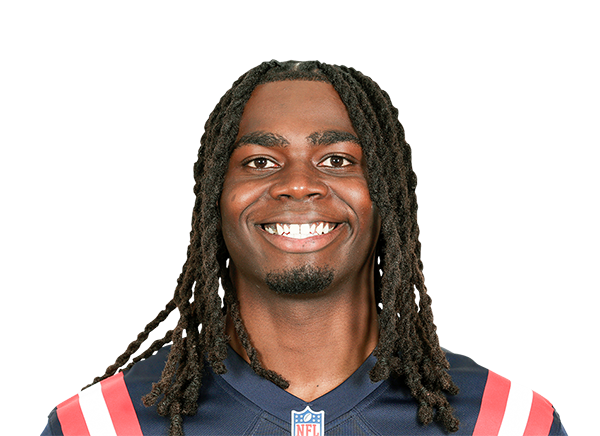
Rhamondre Stevenson is being valued like a committee back in a backfield that no longer has a committee. A market-based fantasy source had him at an ADP of 61 as of November 1, 2026 — the kind of number that gets a player left on waivers in most redraft formats. What he has actually done on the field through seven weeks is a different story: 12.4 PPR points per game, a 63 percent snap share, and a role that reporting from October 29 described as the clear top job in New England's backfield. That gap between what he costs to acquire and what he is producing is the entire case.
The gap is not infinite, and it should not be oversold. Stevenson is averaging 11.0 carries and 3.4 targets per game on the season, and his per-carry efficiency has been middling at 3.7 yards an attempt. This is not a workhorse breaking out. It is a lead back in a passing-game-friendly role whose price has fallen further than his usage justifies — which is a different, more defensible argument than the one that says he is about to become a top-15 back no matter what.
Who Else Is Eating in New England's Backfield
The competition for touches starts with TreVeyon Henderson, the more draft-pedigreed back on the roster, who has not overtaken Stevenson. Reporting from October 29 specifically said Henderson failed to unseat him and that Henderson was also dealing with a nagging ankle issue, which pushed additional work to Corey Kiner rather than to Henderson himself. That is the single most important fact in this evaluation: the Patriots' most talented alternative back is not healthy enough to be a threat to the lead job right now, and even when healthy he has not won the role. New England also added two 2026 draft-class pieces at the position — Jam Miller, a seventh-round pick out of Alabama, and Myles Montgomery, an undrafted free agent signed in May — but neither has displaced Stevenson on the depth chart, and both read as camp-arrival depth rather than touch-share threats today. Drake Maye remains the starting quarterback, Mike Vrabel remains head coach, and Josh McDaniels remains the offensive coordinator and play-caller, so there is no scheme change or new voice calling plays that would independently explain a shift in Stevenson's workload. Hunter Henry is still the Patriots' primary receiving tight end, which caps some of the short-area target competition but does not change the backfield math.
The Clear Top Role Stevenson Has Taken
The strongest piece of evidence here is not a season-long stat line, it is the direction of the role. As of October 31, Stevenson is the first-listed running back on the depth chart, and the reporting around it is specific: he has assumed the clear top job, and he has started to emerge on third down, which is the passing-down role that tends to protect a back's floor even in bad rushing weeks. A back who is both the early-down lead and the emerging third-down option is holding two jobs at once, and that double role is why his receiving numbers — 20 catches on 24 targets for 204 yards through seven weeks — look nothing like a committee back's receiving work. Stevenson himself described the week's emphasis plainly.
“We're hammering it hard this week — the run game.”
— Rhamondre Stevenson
What A.J. Brown's Absence Actually Means for Stevenson
A.J. Brown was ruled out for Week 8 with ankle and knee issues on October 31. The honest version of this argument is narrower than it sounds. Brown had played only two games since returning from an earlier ankle injury, catching nine passes on 20 targets for 101 yards in that stretch, so his absence removes a receiver who was already playing a limited, ramping-up role rather than a fully healthy featured target. There is no direct evidence in the reporting that Brown's absence increases Stevenson's rushing workload — that would be overreaching. What it plausibly does is leave more passing-game volume on the field for the backs and remaining pass-catchers, and Stevenson is the back New England has already shown it trusts on third down. That is a target-share argument, not a touches-guarantee argument, and it should be treated as exactly that.
Why the Efficiency Numbers Give Pause
The case against paying up here is straightforward and deserves to be stated at full strength. Stevenson is averaging 11.0 carries a game and 3.7 yards per carry for the season — modest volume at a modest clip. His week-to-week usage has also been uneven: 13 carries in Week 4, 13 in Week 5, 14 in Week 6, then just six carries in Week 7 despite a big receiving day. A player whose carry total can drop by more than half from one week to the next is not a stable floor play, and projecting him forward as a guaranteed top-15 finisher ignores that volatility. There is also a reported injury absence — three missed games in November 2026 per the team's own player log — though the dates given are inconsistent with the Week 7/Week 8 timeline elsewhere in the reporting, so that detail should be weighed cautiously rather than treated as settled fact.
The answer to that volatility is the receiving role, not the rushing role. Add Stevenson's targets to his carries and even his lightest rushing week — six carries in Week 7 — came with five targets and a touchdown, producing a usable fantasy day anyway. The passing-down role functions as a hedge against bad rushing weeks in a way that a pure between-the-tackles back would not have. That is the difference between a back who is purely touch-volatile and one who is touch-volatile but role-protected.
The Verdict on Stevenson's Price Tag
The tiebreaker is role security, not box-score ceiling. Stevenson is the Patriots' named lead back, Henderson is behind him and currently compromised by an ankle issue rather than threatening to pass him, and the 2026 draft additions at the position have not moved up the depth chart. None of that guarantees a top-15 finish through the fantasy playoffs, and the swings in his carry totals mean some weeks will look thin on the ground. But a lead back with an emerging third-down role, sitting at ADP 61, is priced like a handcuff and used like a starter. The projection for his Week 8 matchup sits at 16.0 points, which is firmly startable production for a player most leagues are not rostering.