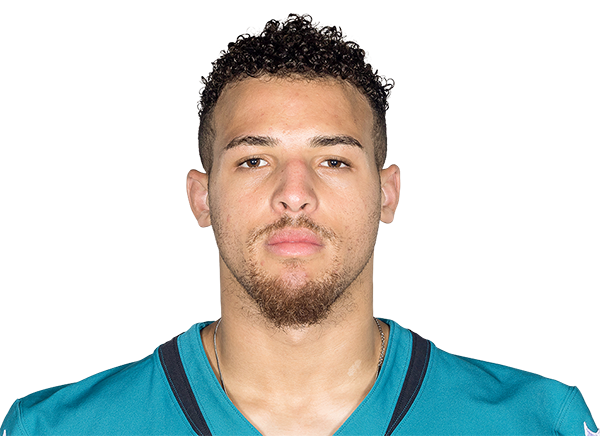
Parker Washington is going off draft boards outside the top 30 wide receivers on several platforms, and that price is stale. The evidence from the second half of last season, the departure of the receiver who used to occupy his exact alignment, and the noise coming out of Jacksonville's camp all point to a receiver who should be drafted as a low-end WR3 with real WR2 upside, not as a bench dart throw. The claim here is specific: Washington finishes in the WR24-30 range as a baseline outcome, and a top-24 finish is the live upside case if the target funnel that opened up for him late last season holds through a full year.
Why now? Because the gap between his 2025 finishing kick and his 2026 draft price hasn't closed yet. Some boards have caught on — FantasyPros has him at WR30 with a seven-day ADP trend of plus-6.7, which is a fast riser by any measure. Other platforms still have him in the WR31-32 range. That spread is the market still arguing with itself about what he is, and it's a window that closes as draft season progresses.
The Situation Now
Trevor Lawrence remains the starting quarterback in Jacksonville, and that continuity matters more than it sounds. Washington's role change last season happened in Lawrence's offense, run through Lawrence's reads, and there is no new quarterback learning curve to worry about in 2026. Grant Udinski was retained as offensive coordinator after the season, so the scheme that created Washington's late-season role is also unchanged. Two of the biggest variables that can quietly gut a receiver's value — a new arm, a new play-caller — simply are not in play here.
The receiver room, on the other hand, did change. Christian Kirk is gone, and Kirk occupied the exact slot and intermediate-route real estate that fed Washington's late-season workload. That volume didn't evaporate; it has to go somewhere, and Washington is the most logical inheritor given how the offense already used him down the stretch. Jakobi Meyers is still in the room — he was acquired in a November 2025 trade and has since been extended — but he sits third on the current depth chart, not first, and there is no departure attached to his name that would suggest he's being pushed out; he's simply not ahead of Washington in the pecking order as things stand.
The more direct threat is Brian Thomas Jr., and it would be dishonest to build a bullish case without naming him. Thomas is the more decorated asset on paper and sits ahead of Washington on our own board by overall rank. But the two do not compete for the same catches. Thomas operates as the outside receiver drawing the tougher coverage matchups; Washington has carved out the underneath, chain-moving role that keeps him schemed open regardless of what coverage is rolled toward Thomas. Notably, Jacksonville's own August depth chart lists Washington as the starting Z receiver ahead of Thomas at that specific spot — a role distinction, not a talent ranking, but a real one. Travis Hunter adds another mouth to feed after being used at wide receiver alongside both of them, and a handful of depth pieces — Josh Cameron, Trebor Pena, Austin Trammell — round out a deeper receiver room than Jacksonville had a year ago. None of those additions occupy the slot role Washington has already claimed, but they are the honest reason his ceiling isn't higher than the WR24-30 range as a baseline.
The Late-Season Sample Is the Real Baseline
Washington's full-season 2025 line — 58 catches, 847 yards, 5 touchdowns, 6.9 fantasy points per game — undersells him, because it blends a slow start with a finish that looked nothing like it. From Week 7 onward, he led the Jaguars in both targets and receptions. Over his final nine games, he averaged 16.5 fantasy points per game, which is WR1-caliber production over a meaningful sample, not a two-week fluke. He also posted a top-12 weekly finish in three of his final six games. That stretch happened with the same quarterback and the same coordinator who are both still in place for 2026, which is the detail that turns a hot streak into a forecast rather than a career highlight reel.
Lawrence's Trust Is the Scarcest Resource on This Roster
Camp reporting has been consistent and specific on one point: Washington is Trevor Lawrence's favorite target. That is not a throwaway compliment. Quarterback chemistry built over an offseason tends to show up in target share before it shows up in box scores, and Jacksonville's coaching staff has reportedly leaned into it.
“Parker Washington has been Trevor Lawrence's favorite target, and he always seems to be open.”
— ESPN, on Jaguars camp
“It has become a daily occurrence during training camp this season as Washington has separated himself as Trevor Lawrence's favorite target...”
— JaguarsWire
Extension talks between Washington's camp and the team remain active, without a deal finalized as of early August. A team does not typically negotiate an extension for a receiver it plans to bury at WR4. The negotiation itself is a signal about how Jacksonville views his long-term role, separate from whatever the final contract terms end up being.
The Counter-Argument: Too Many Mouths at the Trough
The honest bear case does not require inventing anything. Some evaluators still project Washington as Jacksonville's No. 4 wideout rather than a locked-in every-down piece, and that framing has support. He did not play in the Jaguars' preseason opener, which tells you little on its own but does nothing to settle the role question either. Travis Hunter, Brian Thomas Jr., and Jakobi Meyers are all real competition for targets in an offense that only has so many pass attempts to distribute, and a full season of 58-847-5 is a solid but not spectacular receiver season if the target share gets diluted further by that deeper room. If Jacksonville leans more heavily on Thomas as the top read or gives Hunter an expanded receiver role, Washington's target share could plateau rather than grow, and the WR24-30 range becomes a ceiling instead of a baseline.
That case is coherent, but it treats the receiver room as a zero-sum pool without accounting for role separation. Washington's value isn't built on beating Thomas or Hunter for targets — it's built on occupying a slot role that neither of them plays. Christian Kirk's departure removed the only established option in that specific role, and nobody currently on the roster profiles as a like-for-like replacement for it except Washington himself. The bear case is right that the room is crowded; it's wrong to assume crowding automatically caps a player whose production last year came from a lane the newcomers don't occupy.
The Verdict
Parker Washington is not a top-12 lock, and treating him as a hidden true WR2 overstates the case the dossier supports. But he is priced on several boards as if his late-season role never happened, as if Christian Kirk's vacated targets don't exist, and as if Trevor Lawrence's stated preference for him in camp is noise rather than signal. The realistic range is WR24-30 as a floor-to-median outcome, with a top-24 finish available if the slot role holds up over a full season the way it did over Washington's final nine games in 2025. Draft him where the WR30-plus crowd sits on your board, not where the market's slower-moving platforms still have him. The gap between those two prices is the entire trade.