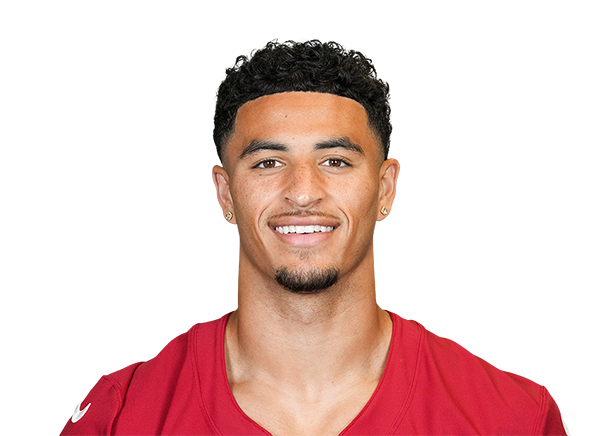
Michael Wilson is a top-15 wide receiver play over his next three games against Detroit, Las Vegas, and San Francisco. That is a conditional claim, not a guarantee, and the condition matters: it holds only as long as Arizona keeps feeding him the target volume he has commanded over the last month. The evidence for that volume is real and recent. The question for any fantasy manager staring at a lineup decision is whether it is sustainable or a two-game mirage.
This is not a speculative add. Wilson has already posted a 1,006-yard, seven-touchdown season in 2025, and the early returns on 2026 suggest his role has not shrunk — it has grown. The case for starting him now rests on recent target share, quarterback continuity, and organizational commitment. All three deserve scrutiny before you plug him into a lineup.
The Harrison Jr., Brissett, and Bourne Puzzle
Nothing about Wilson's role can be evaluated without naming the players standing between him and targets. Marvin Harrison Jr. is the direct competition. Training-camp coverage described Wilson and Harrison as competing for Arizona's No. 1 receiver job, and on Waiver Wizard's own board, Harrison currently sits ahead of Wilson in overall rank even though Wilson holds the WR1 spot on the live depth chart. That is not a settled hierarchy — it is a live competition, and it caps how much target security either man can claim. Kendrick Bourne, signed in free agency, adds a third established body to the room; Arizona's own June roster reset named Bourne alongside Wilson and Harrison as the likely top game-day trio, which means this is not a two-man race for volume but a three-man split.
Jacoby Brissett is the more important variable. He took over for an injured Kyler Murray during the 2025 season and made 12 starts, but he now enters 2026 as the full-time, unquestioned starter — a different situation than a bridge quarterback filling in. That continuity matters because Wilson's production was already built around Brissett: over his final eight games with Brissett at quarterback last season, Wilson averaged 11 targets, seven receptions, and 96.9 yards per game. A full offseason of that same quarterback-receiver rapport, rather than a late-season adjustment period, is the strongest reason to trust the role carries over. Add new head coach Mike LaFleur, whose offensive vision reportedly casts Wilson in a role similar to Puka Nacua's usage in Los Angeles — moved around the formation rather than fixed to one alignment — and the swing variables all point toward more opportunity, not less.
The Target Monster Arizona Finally Built
“Target monster.”
— Alex Clancy, Locked On Cardinals
Clancy's description was not hyperbole detached from the box score. Wilson drew 17 targets against San Francisco, catching 11 passes for 89 yards and a touchdown, then followed with 13 targets against the New York Giants. A fantasy report in early October tallied 30 targets across those two games and had him ranked fifth in the NFL in targets at that point in the season. Clancy went further, arguing Wilson should be getting 15 targets a game and should be moved between outside and slot alignments rather than fixed to one role. A receiver pulling 15-plus looks a game is startable in nearly any matchup, because volume at that level survives bad game scripts and tight coverage alike.
Why Arizona Is Paying Like He's the Guy
Wilson signed a three-year, $75 million contract extension in September 2026, with $47 million guaranteed, running through 2029. That is not the contract of a complementary piece who loses snaps the moment Harrison Jr. has a good camp. It reflects organizational conviction that Wilson is a foundational part of the passing game, and it gives him a level of job security that his on-field competition does not yet have. Combined with his 81% snap share in 2025, the financial commitment and the usage pattern point in the same direction: Arizona built its passing offense around him, not around him as insurance for someone else's absence.
The Seven-Target Week That Should Worry You
The honest counter-argument starts with a two-game sample: before the recent surge, Wilson had only seven targets across his first two games of 2026. If that lower number reflects the offense's true baseline and the 17-target and 13-target games were outliers tied to game script or injuries elsewhere, then projecting a top-15 finish over the next three weeks is premature. Add Wilson's injury history — a shoulder injury that cost him four games in 2023, ankle and hamstring issues in 2024, a foot issue in 2025, and an ankle concern that had him on the injury report with limited practices before Week 7 — and the volatility case gets stronger. A receiver who misses practice time is a receiver whose target share can evaporate in a single game.
- •Counter-evidence: 7 targets across his first two 2026 games versus 30 across the next two
- •Injury flags: shoulder (2023), ankle/hamstring (2024), foot (2025), limited practice ankle issue before Week 7
- •Competition: Marvin Harrison Jr. and Kendrick Bourne both drawing significant snaps and targets
The answer to that objection is not to dismiss it but to weigh it against what came after the slow start. The 17-target and 13-target games happened after the early lull, not before it, which suggests the offense found its rhythm with Wilson at the center of it rather than drifting away from him. He was also cleared off the injury report before Week 7, which indicates the ankle issue was not serious enough to threaten his workload. None of that erases the injury history, but it does mean the most recent, most relevant data point is the surge, not the slow start.
What a Fantasy Manager Should Do Now
Start Wilson over the next three weeks in standard-sized leagues. The target volume is current, the quarterback situation is stable rather than in flux, and the financial commitment from Arizona backs up what the box score is showing. He is not a locked-in top-10 weekly play — Marvin Harrison Jr. and Kendrick Bourne both pull enough volume to cap his ceiling on any given Sunday, and his injury history means his ankle status deserves a Friday-morning check before kickoff. But as a top-15 play across this stretch, the recent evidence supports starting him with confidence rather than hedging with a bench option. If his price in trade talks still reflects the slow two-game start rather than the 30-target surge that followed, that gap is worth exploiting now, before the market catches up.