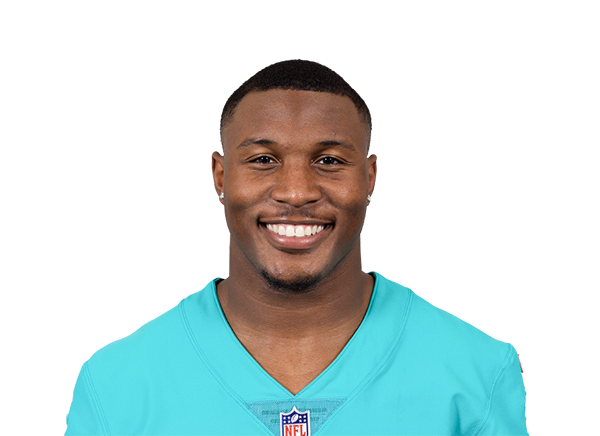
Through four games of the 2026 season, Malik Washington has become Malik Willis's preferred target and Miami's top downfield option. When rookie Caleb Douglas went to the sideline, the Dolphins did not turn to a committee — they turned to Washington. Over the two games immediately following that shift, he caught 10 passes for 123 yards. On October 5, against Minnesota, he caught all five of his targets for 67 yards and led the Dolphins in catches, receiving yards, and targets in a 15-10 loss.
That is the fact pattern that makes this a buy-low case rather than a highlight reel. Washington's team target share sits at roughly 27 percent with an average target depth of 11.2 yards — the profile of an intermediate-route workhorse, not a gadget piece. The problem, and it is a real one, is that Miami is averaging only 25.8 pass attempts per game. A receiver can own more than a quarter of a team's targets and still finish outside the weekly conversation if the team barely throws. That tension is the entire article.
What His 56 Percent Snap Rate Actually Meant in 2025
Washington's 2025 season looks unremarkable on its face: WR54 in PPR scoring, 116.7 total points, 6.9 per game, on 46 catches for 317 yards and three touchdowns across 65 targets. He played 56 percent of Miami's offensive snaps. That is a part-time role, and the box score reflects it. But the context matters more than the total. That season was played with Tua Tagovailoa at quarterback and with Tyreek Hill and Jaylen Waddle both still on the roster, absorbing the lion's share of targets and snaps ahead of him. Washington was, at best, the third option in that passing game for most of the year.
The one signal worth isolating from that season is the finish: 16 catches for 169 yards over his final four games of 2025. That stretch hinted a larger role was available to him before the current situation ever existed. It does not prove his role was consistently large all season — it wasn't, hence the 56 percent snap share — but it does suggest the current expansion is not happening in a vacuum. The quarterback, the top two receivers, and the head coach who called the 2025 season are all gone. None of the conditions that produced the WR54 finish still hold.
Hill, Waddle, and the Receivers Now Competing With Him
The departures are the bigger story than any competition that arrived to replace them. Tyreek Hill was released in February 2026, vacating a huge share of targets and snaps outright. Jaylen Waddle was traded to the Denver Broncos in March, along with a fourth-round pick, in exchange for first-, third-, and fourth-round picks — a full veteran receiver corps wiped out in two offseason moves. Tua Tagovailoa was released in March as well, with Malik Willis now expected to start at quarterback. Jeff Hafley replaced Mike McDaniel as head coach in January, which changes the leadership structure even though the available information does not identify a new offensive coordinator.
Miami did not leave the room empty. Jalen Tolbert and Tutu Atwell both signed in free agency, and the draft brought in three rookie receivers — Caleb Douglas, Chris Bell, and Kevin Coleman Jr. That is five new bodies competing for snaps. But Washington is the one listed as the starter ahead of Coleman Jr. on Miami's unofficial depth chart, and the team's own training-camp materials described him as one of the longest-tenured receivers on the roster, pointing to a larger role in the rebuilt room rather than a smaller one. Douglas was the player positioned to challenge him most directly, and it was Douglas's absence that triggered Washington's expanded role in the first place. Tolbert and Atwell have added competition for perimeter snaps, but neither has displaced Washington as Willis's top target through four games.
“I think we've made a ton of progress, and I say that, but I recognize that there's still a long way to go. We got to clean up our penalties. We got to play a little bit cleaner football.”
— Malik Washington
The Case That Miami Simply Won't Throw Enough
The strongest objection to buying in here is not about Washington's talent — it is about Miami's offense. Twenty-five point eight pass attempts per game is a run-heavy number, and the Minnesota performance that put Washington on fantasy radars came in a game where Willis attempted only 17 passes. Zero touchdowns on 28 targets through four games is also real, and a receiver who gains a target share only after an injury to the player ahead of him is, by definition, in a role that could reverse the moment that player returns. The market has priced this skeptically: one source had him around ADP 190 in early October, and another listing showed him as WR82 with no consensus draft position at all. That is a near-irrelevant price for a player anyone is calling a top-20 finisher.
The answer to that case is not to dismiss it — it is correct that Miami's pass volume caps Washington's ceiling, and it is correct that a top-20 finish is not yet supported by the evidence. But a 27 percent target share and an 11.2-yard average depth of target describe a real route-running role, not a product of garbage-time rushes. Douglas's absence created the opening, but Washington is the one the Dolphins chose to feed once it opened, over three other newly added receivers. That decision, made by a new coaching staff with no incentive to defer to incumbents, is the more telling signal than the box score from any single game.
The Call: A Priority Waiver Add, Not a Lineup Lock
Washington does not project as a top-20 receiver this season on the evidence available today — the passing-volume ceiling and the absence of a single touchdown through four games make that too aggressive a claim to stand behind. What the evidence does support is a receiver whose target share already rivals a true No. 1 option, operating in an offense that has no proven alternative ahead of him after trading away or releasing its top two weapons from a year ago. That combination — real role, suppressed price — is exactly what a buy-low move is supposed to find.
- •Add him in redraft leagues with flex or bench depth available; his price (WR82, little-to-no draft capital) badly undersells his current target share.
- •Monitor what happens if Douglas returns healthy — that is the single event most likely to cap Washington's route share again.
- •Treat him as a flex option in PPR formats rather than a confident weekly starter until Miami's touchdown opportunities start matching the target volume.