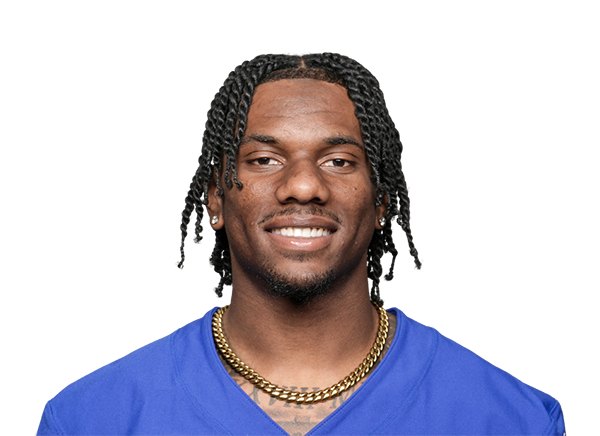
Malik Nabers finishes outside the top-15 PPR wide receivers in 2026. That is the claim, and it runs directly against where he is being drafted, which is closer to a top-10 receiver than a fringe WR2. The gap between that price and the current state of his situation is the entire argument.
Nabers is talented enough to make this claim uncomfortable. When healthy in 2024, he looked like a true alpha. The problem is that 2026 is not 2024. He is coming off a torn ACL and meniscus, he did not suit up for the preseason opener, and as of mid-August he was still being managed in a non-contact jersey during a ramp-up period rather than cleared for full football activity. Price should reflect that uncertainty. It does not appear to.
The Situation Now
The passing game around Nabers changed more than his own role did. Jaxson Dart is the expected quarterback for 2026, a change from last season's setup, and he enters the year as a second-year passer learning a new system under new offensive coordinator Matt Nagy. The Giants also have a new head coach in John Harbaugh, replacing the previous staff. That is three new variables — quarterback continuity, play-caller, and head coach — stacked on top of a receiver who is himself returning from a serious knee injury. None of that guarantees failure, but it removes the kind of offensive stability that normally underwrites a top-10 wide receiver price tag.
The receiver room also got more crowded, not less. The Giants added Darnell Mooney and Calvin Austin in March 2026, then layered in Odell Beckham Jr., JuJu Smith-Schuster, and Braxton Berrios as low-cost veteran additions in June, and used a third-round pick in April on Malachi Fields. No receiver clearly departed to create a vacancy — instead, the team built depth around Nabers rather than replacing outgoing volume. Nabers still projects as the Giants' top wideout when healthy, and the current camp reporting still treats him as the passing game's focal point. But a rookie-caliber-in-continuity quarterback learning a new offense, throwing to a suddenly deep receiver room, is a different target-efficiency environment than the one that produced his 2024 rookie numbers.
A Passing Game Still Finding Its Floor
The core fade case does not require doubting Nabers' talent. It requires acknowledging that the Giants' offensive environment has not shown the efficiency that typically supports a top-10 wide receiver outcome. Dart is a second-year quarterback adjusting to a new coordinator's system, and new coordinators installing new systems in year one are not known for immediate rhythm, particularly with a passer who has one season of NFL experience. A receiver's ceiling is capped by what his quarterback and scheme can deliver, no matter how good his separation or catch radius is.
The Room Got Crowded, Not Cleared
Target competition matters even for a true WR1. Mooney, Austin, Beckham, Smith-Schuster, Berrios, and Fields will not individually threaten Nabers' role at the top of the depth chart, but collectively they give Dart more places to go with the ball, especially early in the season if Nabers is still working back into full speed. A crowded room does not need to demote a WR1 to cap his target share — it only needs to siphon off the marginal targets that separate a top-8 finish from a top-20 one.
The Recovery Timeline Doesn't Match the ADP Clock
Nabers' 2025 season ended after four games because of the torn ACL and meniscus, and his 2026 offseason was delayed by a spring cleanup procedure. He returned to full-speed team drills only in mid-August, was still described as not fully at full speed after that session, and one report as late as Aug. 18 had him not yet declaring himself ready for the season opener. That is not a player whose availability and early-season role should be priced as a lock. Fantasy drafters are paying for a full, efficient season from a receiver who has not yet proven he can handle a full practice slate, let alone a full game slate against a real pass rush.
The Counter-Argument
The strongest case against this fade is straightforward: Nabers has already shown true alpha-receiver traits, and the Giants continue to build the passing game around him. In his four-game 2025 sample, he averaged 14.3 fantasy points per game, and his rookie season produced 109 catches for 1,204 yards and 7 touchdowns. Head coach John Harbaugh said on Aug. 17 that Nabers is “doing great,” and Nabers himself described returning to team drills as bringing “my soul back to life.” Elite target earners can outrun weak surrounding offenses if the volume is concentrated enough on one player, and a healthy Nabers could still finish top-15 purely on role.
“He's doing great.”
— John Harbaugh
That counter-argument deserves respect, because it is not wrong about his talent. But it leans on a 2024 sample from an offense that no longer exists in its previous form and a four-game 2025 stretch too small to establish that his early-2026 role will look the same under a new quarterback and coordinator. Harbaugh's own qualifier — that Nabers is “not at full speed yet” — undercuts the idea that he is a locked-in, full-workload option from Week 1. A player still ramping back from a torn ACL, throwing to a first-year-starting quarterback in a first-year system, with five new bodies added to his receiver room, is not the same bet as the player who was in that Aug. 15 preseason opener. The fact that Nabers did not play in it is itself part of the case.
The Verdict
The claim stands: Nabers finishes outside the top-15 PPR wide receivers in 2026, undercut by an ACL recovery that has not yet cleared him to full speed, a new quarterback-and-coordinator pairing still building rhythm, and a receiver room that got measurably more crowded without losing volume elsewhere. None of this argues that Nabers lacks talent. It argues that his current draft price assumes a healthy, efficient, uncontested WR1 season that the available evidence does not yet support.
For fantasy managers, the practical approach is patience. Let him fall past his current market price, monitor his practice reports through the preseason for confirmation he is truly at full speed, and treat any slide into the WR15-to-20 range as the moment his risk and price finally match. Drafting him at a top-10 cost today means paying for the 2024 version of Malik Nabers in an offense that no longer exists.