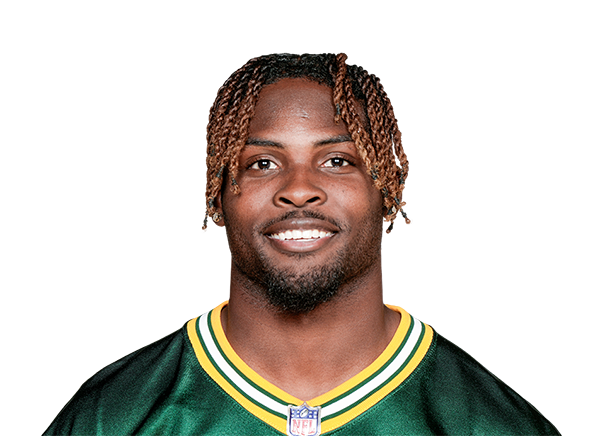
The consensus case against Jayden Reed is not built on ignorance. It is built on two straightforward facts: he has missed significant time to injury, and Green Bay's passing offense has never funneled targets to one receiver the way some other systems do. Draft him and you are paying for a talented but inconsistent piece in a crowded room, not a set-it-and-forget-it WR2. FantasyPros had him around WR48 overall in consensus ADP in late August, another tracker put him near WR44 at pick 94, and a third had him rising to WR42. ESPN's Eric Karabell placed him in Tier 12, WR50 in his own rankings. That is not a fringe opinion. That is the market, from multiple independent sources, agreeing that Reed is a WR4/WR5-caliber pick. A reader who takes that view seriously is not being lazy. They are pricing in real downside.
The Golden and Watson Question Green Bay Still Has To Answer
What that ADP is actually pricing in is the shape of Green Bay's receiver room as it exists right now. Matthew Golden, the team's 2025 first-round pick, is part of the passing-game core entering 2026, and Christian Watson remains in the mix as well. Jordan Love is still the starting quarterback, and Matt LaFleur is still calling the offense, with Adam Stenavich as offensive coordinator. That is a offense that has historically leaned on motion and spreading the ball around rather than concentrating volume on a single receiver, and three legitimate pass-catchers competing for targets in that structure is exactly the kind of situation that keeps a player's weekly ceiling capped. If you think Reed is going to see the target volume of a true WR1, the presence of Golden and Watson is the reason to doubt it. That skepticism is reasonable on its face.
What the Doubs and Wicks Exits Actually Change
But the room the market is pricing is not the same room that existed last season. Romeo Doubs and Dontayvion Wicks, both notable contributors in Green Bay's passing game, are gone this offseason. Those two took real snaps and real targets away from Reed in previous years, and their departure is not a minor roster footnote — it is the single biggest change to Reed's competitive environment heading into 2026. The receiver room has been reshaped around Reed, Watson, and Golden specifically because Doubs and Wicks are no longer soaking up looks. An ADP built on last year's target distribution, before two contributing receivers left, is measuring a version of the offense that no longer exists. That is the core of the mispricing: the market has not fully repriced Reed for a target pool that just lost two participants.
The Efficiency Number the ADP Isn't Crediting
The stronger case for Reed is not speculative, it is already in the box score. Across a healthy 17-game sample over the past two seasons, Reed averaged 12.3 PPR points per game, a rate that would have ranked around WR22 in 2026 scoring context. That is the floor case on games he actually plays. The ceiling case is the per-target efficiency: Reed ranks as the WR1 in fantasy points per target since entering the league, and in games where he saw at least six targets, he averaged 17.5 PPR points per game. That second number is the one that matters most given the departures above. Reed does not need a target overhaul to become a weekly difference-maker — he needs the target bump that naturally follows from Doubs and Wicks no longer being on the roster. Green Bay also removed any financial reason to limit his role: Reed signed a three-year, $50.25 million extension in April, which signals the team views him as a continued priority rather than a trade candidate or cap casualty.
“With the recent WR departures, Reed will have as good a chance as ever to reach his potential in 2026.”
— Justin Boone
Boone also called Reed's outlook "a massive fantasy ceiling" while still filing him as "a fantasy WR4/flex with upside" — which is itself a version of the mispricing. The public projection lands on modest floor language even while acknowledging the ceiling case is real.
The Injury Discount That's Doing Most of the Work
None of this erases the residual risk, and it would be dishonest to pretend otherwise. Reed played only 7 games in 2025, limited by foot and collarbone injuries, and he was ruled out of a preseason game in Denver on Aug. 21, 2026. That is a recent, specific data point, not an old injury history being unfairly held against him. The counter-argument that matters is not about talent — it is about whether Green Bay's target distribution, even with Doubs and Wicks gone, still spreads enough volume across Golden and Watson that Reed never sees the six-plus target games that unlock his 17.5-point ceiling. If LaFleur's offense keeps target shares flat rather than concentrated, Reed's weekly outcomes could remain closer to boom-or-bust flex play than true WR2 stability. Health and target concentration both have to break in Reed's favor at the same time. That is a real conjunction of conditions, not a guarantee.
Given all of that, a top-12 finish is more than the evidence supports — even the strongest bull case here requires both a target spike and a health year Reed hasn't put together recently, and the dossier itself frames that outcome as unlikely rather than probable. The claim that holds up is more modest and still well ahead of the market: a healthy, expanded-role Reed profiles as a top-24 receiver, a low-end WR2, being drafted as if he's a fringe WR5. Draft him where the market has him — outside the top 40 at the position — and the expected return is a strong WR2/flex outcome with WR1-week upside on the games he sees real volume. That gap between WR45 price and WR24 expectation is the mispricing worth acting on.