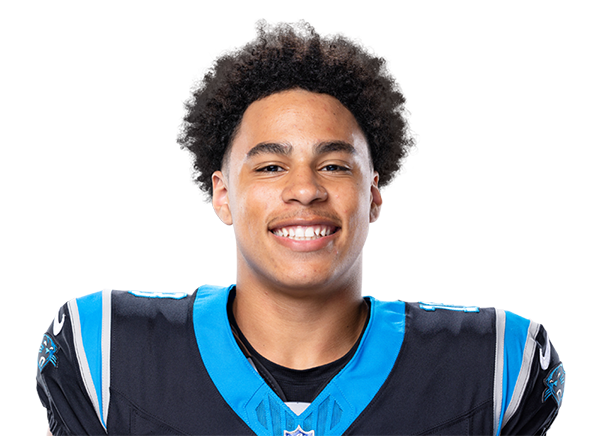
Two things happened to Jalen Coker within a few months of each other, and either one alone would be a notable story. In June 2026, Carolina signed him to a three-year extension worth $35 million in base value, taking him from restricted-tender depth piece to a player under contract through 2029. Then, in Week 1, he went out and made the front office look prescient: 8 catches on 9 targets for 138 yards and 2 touchdowns against Chicago, on 57 of a possible 68 offensive snaps. That single-game yardage and touchdown total already exceeded his entire 2025 season line.
That is the change. Not a scheme gimmick, not a one-week fluke buried in garbage time — a receiver who signed a multi-year deal in the spring because the team viewed him as a building block, then went out in Week 1 and posted the best game of his career. The question this article has to answer is whether that combination is enough to project a top-24 finish over a full season, or whether it is one hot week wrapped around a contract that was as much about cost certainty as star power.
What Coker Was Before, and Why That Role No Longer Applies
The 2025 version of Coker was a modest complementary piece: 33 receptions, 394 yards, and 3 touchdowns across 11 games, a season also limited by injury. That was a player operating behind Xavier Legette in the pecking order, without the security of a long-term deal, on an exclusive-rights tender he didn't sign until April 2026. None of that description holds anymore. The tender is gone, replaced by a three-year commitment. The injury-limited depth role is gone, replaced by spring reporting that described him as a focal point of the passing game and Carolina's No. 2 receiver. The quarterback is the same — Bryce Young returns as the starter, so there's no QB-change asterisk here — but the receiver hierarchy underneath him has clearly shifted, and Coker is no longer occupying the same seat he held a year ago.
The Ankle, the Boot, and a Depth Chart That Didn't Move
Coker left his Week 1 breakout with a left ankle injury and was reported to be in a walking boot afterward. That is a real red flag for a player whose 2025 season was already shortened by injury, and it deserves weight rather than dismissal. But the more telling data point is what didn't happen next: Carolina's Week 2 depth chart still listed Coker as a starter in the 3-WR alignment alongside Tetairoa McMillan and Legette. A team that viewed the injury as role-threatening would have signaled it through the depth chart. It didn't. Coker himself described the issue as precautionary in the aftermath, and head coach Dave Canales said the plan was to ramp him up through the week and "cut him loose" Friday after a few practice reps — the language of a team managing a starter's workload, not searching for his replacement.
Legette and McMillan: What Each One Costs Him
The target competition around Coker is real, and it starts with McMillan, Carolina's first-round rookie who immediately became a major share-contender at receiver. McMillan dealt with a foot issue during spring workouts, but draft capital and offensive design tend to funnel early looks to first-round rookies regardless of early hiccups — he is the most credible threat to cap Coker's ceiling as a true alpha target earner. Legette remains the other name in the mix, still listed among Carolina's top three receiving options on the current depth chart. What matters here is sequencing: in the one game with a full sample this season, it was Coker, not Legette, who drew 9 targets and played 84 percent of the offensive snaps. That doesn't erase Legette from the equation, but it is evidence that the pecking order coaches are actually deploying on Sundays already favors Coker over the incumbent he used to play behind.
What Happens When Idzik Calls the Plays
The other change worth naming is on the headset, not the roster. Brad Idzik is expected to take over play-calling duties in 2026, inheriting that job from Canales, who remains head coach. This is not a coordinator hire from outside the building or a scheme overhaul — Canales stays involved, and the 3WR/1TE structure that put Coker on the field in Week 1 is unchanged. The honest read is that this is a lower-variance change than a new offensive system would be, but it is still an unknown: a full season of live sample under a new primary play-caller could shift target distribution in ways that either reward Coker's route profile or dilute it. One week of data cannot settle that question either way, and it deserves to be flagged as a genuine uncertainty rather than waved away.
The Case Against a Top-24 Finish
The strongest counter-argument here isn't the ankle — it's the crowd. Carolina still runs three real receivers on early downs, and McMillan's rookie pedigree plus Legette's continued presence in the starting mix means Coker's targets are not guaranteed to be the offense's second-most-valuable air-yards allocation over seventeen weeks. A player can be a legitimate No. 2 receiver on paper and still finish outside the top-24 if a rookie with first-round investment behind him accelerates faster than expected, or if the ankle becomes a recurring issue the way durability concerns dogged his 2025 season. The market is pricing in exactly this skepticism: an ADP of 137.4 makes Coker the 54th receiver drafted, a number that reflects a mid-round flier rather than a locked-in starter, despite the contract and the Week 1 explosion.
The answer to that case is not to dismiss it but to note what has actually changed underneath it. A three-year extension is not how teams pay complementary depth pieces who are expected to lose reps to a rookie — it's how they pay players they intend to build the passing game around. Combined with a snap share above 80 percent in the only fully healthy data point available and coaching language describing him as a focal point, the evidence points toward a receiver whose role has genuinely expanded, not one riding a single box score.
The Call
Coker is a buy in any format where he can still be acquired near his current market price. The combination of contract security, a starting perimeter role in a 3-WR structure, and a Week 1 workload that already outstripped his prior full season is a stronger signal than a 12th-round ADP reflects. The ankle is the variable to track — a lingering issue would undercut the whole thesis — but the depth chart, the coaching language, and the extension all point the same direction. Roster him now, before the price catches up to the role.