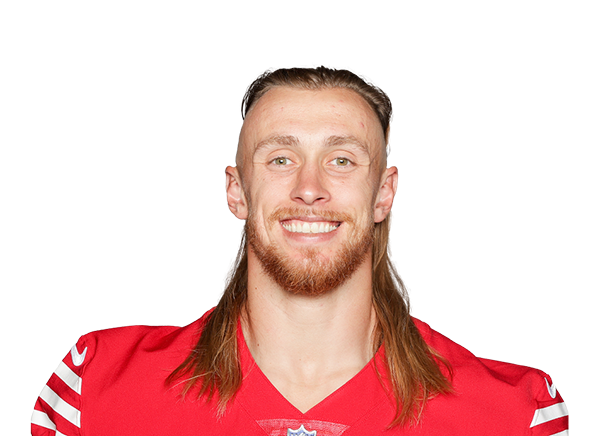
George Kittle is going off the board around TE10 in Sleeper leagues and TE11 in ESPN formats, with one recent report placing him around pick 104 overall. That is a price that assumes he walks into Week 1 as the same mismatch weapon he has always been. The problem is not that the assumption is wrong. It is that it is not yet confirmed, and the gap between confirmed and assumed is exactly where fantasy value gets lost.
Kittle returned to practice in full pads in late August and was activated from the PUP list, both genuinely good signs. But as of that same report, he was working individually rather than in team drills. A TE10-11 price tag is a bet that the remaining ramp goes smoothly and produces a full, unrestricted Week 1 role. That is a reasonable bet. It is not a settled one, and right now the market is pricing him as if it were.
Who Else Is Eating in San Francisco's Offense
The context around Kittle has not changed as much as the injury headlines suggest. Brock Purdy remains the starting quarterback after a major offseason extension, and Kyle Shanahan remains the play-caller, so the passing structure that has always funneled work to Kittle is intact. Christian McCaffrey is still the lead back and still commands touches that could otherwise flow to the tight end in the short and intermediate game. Mike Evans arrived as a veteran outside receiving weapon, and while he does not compete with Kittle for the same routes, his presence gives Purdy another read that can pull volume away from the middle of the field on any given snap.
At tight end itself, Jake Tonges re-signed with the 49ers as a restricted free agent and is the clearest player positioned to eat into Kittle's snaps if the team wants to manage his post-Achilles workload early in the season. On the other side of the ledger, Kendrick Bourne and Skyy Moore both left in free agency, which removes competition for targets rather than adds it. Net effect: the receiving volume vacated by departures is real, but the presence of Tonges as a load-management option is the one new variable that could cap Kittle's early-season role even if he is technically active.
The Medical News Has Genuinely Improved
The strongest reason to pay the price is that the recovery has tracked better than the original injury would suggest. Kittle tore his right Achilles on January 11, 2026, in a playoff win over Philadelphia, and the typical recovery window for that injury runs eight to ten months. Getting activated from PUP and working in full pads by late August is ahead of a grim-case timeline. John Lynch said Kittle's rehab was 'coming tremendous' and that he was 'doing everything possible to be ready for week one.' Reporting after the PUP activation indicated Kittle would, barring a setback, be back at some point in the first four weeks. None of that is a guarantee, but it is a real signal that the floor outcome — a lost season — is now unlikely.
Purdy and Shanahan Still Need a Mismatch Piece
The second case for paying the price is structural. Nothing about the coaching staff, the quarterback, or the offensive system has changed. Kittle's own public comments after the injury reflected confidence that he would not miss much of the season, and the team extended him in the offseason, which signals the front office still views him as a central piece rather than a fading asset to be phased out. Shanahan's offense has always used its tight end as a mismatch creator against linebackers and safeties, and Purdy has thrown to that concept for his entire starting career. If Kittle is active and reasonably healthy, the target competition around him — Evans on the outside, McCaffrey underneath, Tonges as a complementary piece — does not obviously reduce his role in the passing game the way a genuine target-share thief would.
The Case for Fading Him at This Price
The honest counter-argument is that the recovery has gone well enough that the fade thesis is weaker than it looks on paper. Kittle's route volume and after-catch ability have not disappeared, the surrounding cast has not added a direct positional threat beyond a depth tight end, and the medical updates through late August were all positive. If he is active by Week 1 or shortly after with no lingering snap restriction, there is a real path to a finish that justifies a TE10-11 price, and betting against that outright would be overreacting to an injury that, by all current reporting, is healing on schedule or ahead of it.
The answer to that case is not that the medical news is bad. It is that the price already assumes the good version of the medical news, and the version that has actually been confirmed so far is more modest: individual work in pads, no team drills yet, and a stated four-week runway for return rather than a guaranteed Week 1 slot. An Achilles recovery that is ahead of schedule in August can still produce a snap count that is capped in September if the coaching staff eases him in, which is a normal and prudent way to handle that injury. A capped early role, even briefly, is enough to knock a TE10-11 price down to a mid-tier finish, because tight end scoring is concentrated at the very top and even a few weeks of reduced usage are hard to recover from in a full-season format.
Where This Leaves the Draft-Day Call
The tiebreaker here is that a TE10-11 price is not a discount. It is a price that already reflects the encouraging medical updates, and it leaves very little room for the normal uncertainty that comes with any Achilles recovery this early in a season. The market moved in Kittle's favor once the PUP activation news broke, which means anyone drafting him now is paying for the optimistic outcome, not getting ahead of it.
The practical instruction: do not reach for Kittle as a locked-in top-tier tight end at his current draft slot. If he is available a round later than his current TE10-11 cost, the risk-reward improves meaningfully, because you are then paying for the median outcome rather than the best-case one. If he is gone by the time your queue turns to tight end at that discounted range, there is no need to chase him back up the board — the players just behind him on scheme-stable offenses represent a safer bet at a comparable price.