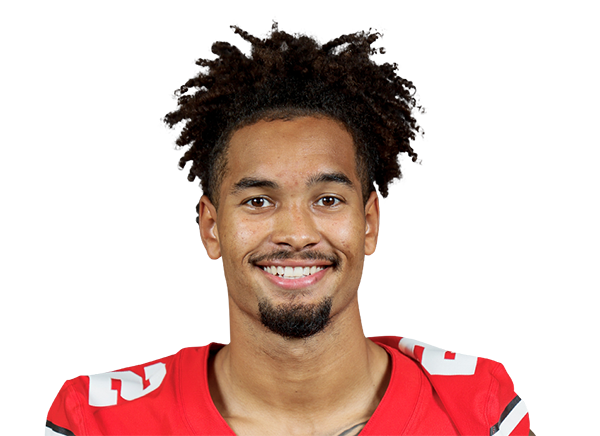
The consensus view on Emeka Egbuka is not dismissive, it is cautious, and that caution is reasonable on its face. Draft boards have him clustered in the WR17-to-WR19 range, with one outlet slotting him 42nd overall and another pegging him as the WR17 off the board in the late fourth round. A Footballguys evaluation framed him plainly as a risk-reward WR2 and priced his 2026 cost accordingly, in the WR18 range. That is not a bust label. It is a fair, mid-tier valuation that already assumes he takes a step forward.
The case for staying cautious gets stronger once you add the injury. A toe issue surfaced in late August, and while the team was not described as alarmed, a Week 1 availability question is a real one. One fantasy analysis published around the same time argued Egbuka "should remain a strong WR2 bet in the third or fourth round of most drafts" — provided the injury does not prove worse than expected. Read charitably, the market has already given him credit for a bigger role. Asking for a top-12 or top-15 finish on top of that discount is, in this view, asking the price to be wrong twice.
What the WR17 Price Is Actually Pricing In
To understand why that price might still be too low, look at everything that changed in Tampa Bay's passing game this offseason. Mike Evans, the team's long-time top receiving option, left in free agency and signed with San Francisco. Tampa Bay also fired offensive coordinator Josh Grizzard in January and let go of quarterbacks coach Thad Lewis. In their place, the Buccaneers hired Zac Robinson as offensive coordinator, added Chandler Whitmer as quarterbacks coach, brought in T.J. Yates as pass game coordinator, and later added Ken Zampese as a senior offensive assistant and pass game specialist. The receiver room saw one clearly identified new addition, Ted Hurst III, who made the initial 53-man roster. What did not change is the quarterback: Baker Mayfield is still expected to start, still throwing to the same building blocks he had last year, just under new offensive leadership. On the depth chart, Egbuka now sits as the clear WR1 ahead of Chris Godwin Jr., while Bucky Irving remains the lead back and Kenny Gainwell sits behind him — a backfield that does not project to siphon a heavy share of passing-game work away from the perimeter.
The Target Vacuum Mike Evans Left Behind
A departure of Evans's magnitude does not just remove a name, it removes targets that have to go somewhere. Godwin is still on the roster and still capable, but he is now nine years into his career and sits behind Egbuka on the depth chart rather than ahead of him. That ordering matters. It means the offense's new coordinator inherited a room where the clearest, most explosive weapon is already installed as the primary option, not competing for that status. When an offense loses its top veteran target and does not replace him with another proven X-receiver, the most likely outcome is consolidation behind the next man up, not an even split. Egbuka is that next man.
A New Play-Caller, the Same Quarterback
The counter-argument would carry more weight if Tampa Bay had also changed quarterbacks, forcing Egbuka to build chemistry with a new passer while adjusting to a new scheme. That is not what happened. Baker Mayfield returns as the starter, which means Zac Robinson's new offense is being installed with quarterback continuity rather than a full reset. That combination — a retained, established quarterback learning a new system alongside his top receiver, rather than both learning each other from scratch — tends to shorten the adjustment period. It is also consistent with the shape of the projections already on the board. One 2026 projection has Egbuka at 78 receptions, 1,046 receiving yards, and 7 touchdowns. A separate model, working from an 8.3-targets-per-game and 65-yards-per-game pace, points to a similar 17-game trajectory. Both sit meaningfully above his 2025 line of 63 catches, 938 yards, and 6 touchdowns, and both were published after the coaching changes and the Evans departure were already known.
The Injury Discount Nobody Should Pay For Twice
The toe injury is real and worth tracking, but it is worth being precise about what it has actually done to the market. Reports have not shown a sharp collapse in Egbuka's price. Instead, coverage describes a modest discount tied directly to the injury, with one outlook piece stating outright that the injury-driven price dip makes him more attractive at his current cost, not less. If that discount is already baked into a fourth-round price, then drafting him there is not betting against the injury — it is being paid to accept a risk the market has already discounted once. Betting the injury resolves without lingering effects is the same bet the current ADP is already making at a cheaper price than his underlying role deserves.
What Still Has to Break Right
None of this is a sure thing, and the honest version of this argument has to say so. The toe needs to heal cleanly enough that it does not cost him snaps or explosiveness into the season. Godwin, even lower on the depth chart, still has nine years of NFL experience and could still siphon high-value targets in exactly the situations — third down, red zone, obvious passing downs — where target competition actually decides fantasy outcomes. And the deeper risk flagged around this profile is real: if Egbuka settles in as merely a solid, unspectacular WR2 rather than the offense's clear focal point, a top-12 or top-15 overall finish becomes a stretch regardless of how favorable the situation looks on paper. The 1,000-yard threshold is reachable on the current projections, but it is not guaranteed, and health remains the single variable most likely to undo it.
The Path Egbuka Has Actually Earned
Line up the pieces: the top veteran target is gone, the offensive staff has been rebuilt around a retained starting quarterback, and Egbuka already sits atop the receiver depth chart rather than fighting for that spot. That is not a speculative breakout profile. It is a role that has already been assigned, priced by the market as if it were still uncertain. The realistic outcome is a top-15 finish with receiving yardage clearing four figures, built on a target share that a WR17-to-WR19 price does not fully reflect. A true top-12 finish is possible if the health risk clears and the offense consolidates as expected, but it should be treated as the ceiling, not the baseline expectation.