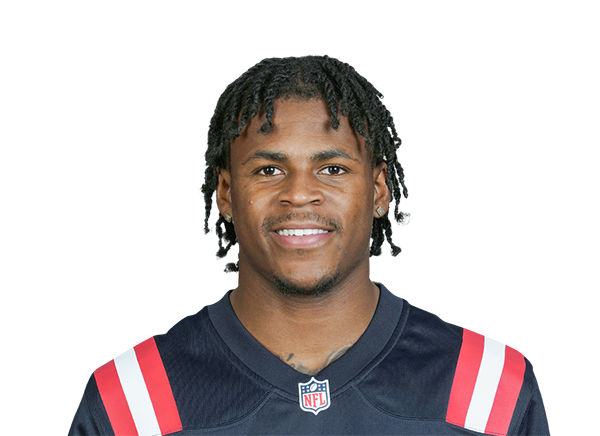
DeMario Douglas is not going to finish as a top-20 wide receiver this season. That claim doesn't survive contact with his own track record — a WR65 finish in 2025 on 31 catches for 447 yards makes that bar too high to defend. But a more defensible version of the same idea does hold up: Douglas's playing time has been climbing for real reasons, not accidental ones, and the version of him on the field right now is a legitimate weekly flex option, not a two-week mirage.
That distinction matters because of timing. New England just placed Romeo Doubs on injured reserve and Mack Hollins remains out, which strips two bodies out of the receiver room in the same stretch Douglas produced his best football of the season. The question for any manager scanning the waiver wire isn't whether Douglas got hot — he did — it's whether the opportunity behind that heat is still there next week. The evidence says it is.
The Receiver Room Behind Drake Maye Right Now
Douglas is currently listed as New England's No. 3 wide receiver, behind A.J. Brown and Kyle Williams. Brown was acquired in a trade before the season and immediately became the Patriots' lead outside option — he is not going anywhere, and he caps Douglas's ceiling as a true WR1 in this offense. Romeo Doubs signed in free agency to compete for outside snaps and targets, but a shoulder injury suffered against the Jets put him on injured reserve, removing a direct competitor for offensive snaps. Mack Hollins was already sidelined with a calf injury. That leaves Brown, Douglas, Williams and Efton Chism III as the primary receivers New England can actually deploy — and Chism, an undrafted slot competitor already on the roster, is the only player positioned to cut into Douglas's underneath work.
New England also traded Kayshon Boutte to Houston during the offseason, which removed a 2025 contributor (33 catches, 551 yards, six touchdowns) from the target pool, though his role was more outside-oriented and didn't directly overlap with Douglas's slot responsibilities. Drake Maye remains the starting quarterback, so there is no passer change to complicate the read. The net effect: the receiver room got more crowded on paper when Brown and Doubs arrived, but injuries have since thinned it back out at exactly the moment Douglas needed room to operate.
The Snap Share Climbed Before the Touchdowns Did
The single most useful fact in this profile is sequencing. Douglas's snap share rose from 49% in Week 5 against Las Vegas to 59% — 40 offensive snaps — in Week 6 against the New York Jets. That increase happened alongside the receiver-room attrition, not as a result of one big game. Through Week 6 he had played 54% of New England's offensive snaps and commanded a 17% target share, which is a real, measurable share of the passing offense rather than a product of garbage-time work. This is the detail that separates a buy-low case from wishful thinking: the opportunity expanded first, and the production followed, which is the opposite order of a classic touchdown-variance mirage.
Two Games That Look Like a Role, Not a Fluke
Over the Las Vegas and Jets games, Douglas totaled 11 receptions for 151 yards and three touchdowns. In the Jets game alone he caught seven passes for 86 yards and a touchdown, leading the Patriots in receiving that week. Two games is a modest sample, and the dossier is explicit that it doesn't by itself prove a full-season outcome. But paired with the snap-share trend, it reads as a role catching up to usage rather than a receiver who got hot independent of his playing time. Douglas has operated primarily as a slot/underneath receiver, which is a lower-variance role than a boundary alpha — the kind of role that produces steady target volume for a quick-completion weapon rather than boom-or-bust spike weeks.
“I'm not going to lie, I wanted the endzone so bad. That's what got me in trouble.”
— DeMario Douglas
That quote followed the Jets game, where Douglas also lost a fourth-quarter fumble chasing the end zone. It's a minor red flag on ball security, but it also reflects a player who is now being trusted with the ball enough to be in position to make mistakes near the goal line — a different problem than a receiver who can't get targeted at all.
The Case Against Trusting the Spike
The strongest objection here deserves to be stated plainly: Douglas is still the No. 3 receiver on his own team, not an emerging alpha. A.J. Brown remains the unquestioned top target, and nothing in the current role projects Douglas past him. His 2025 season — 31 catches, 447 yards, three touchdowns, a WR65 finish — shows that increased playing time has historically failed to translate into meaningful fantasy production for him. His red-zone share through Week 6 sat at just 8% of the team's opportunities, which is thin for a player who just scored twice in two weeks; touchdown streaks built on a small red-zone share tend to regress. And the market reflects real skepticism — one fantasy board reported no consensus draft rank or tier for Douglas as of mid-October, meaning the wider industry simply hasn't priced this role change in yet.
That skepticism is reasonable, but it's backward-looking. A 95.8-point PPR season happened in an offense where Douglas competed with a different, more crowded receiver group for touches. The conditions that produced WR65 — Brown's workload not yet established, a deeper rotation including Doubs and Hollins both healthy — no longer apply. Two players are now on injured reserve. The role has not caught up with the market price because the market hasn't been given a number to work with yet, not because the underlying opportunity isn't there.
What to Actually Do About It
Treat this as a waiver claim, not a trade target, and treat the ceiling honestly. Douglas is not a replacement for Brown, and nothing in his profile suggests he becomes New England's primary read. But as long as Doubs and Hollins remain out, the slot role he occupies carries a real, rising target share in an offense run by a healthy starting quarterback — that is a flex-caliber weekly floor in most formats, with spike-week upside given the recent touchdown rate. Add him where available, start him as a flex option while the receiver room stays thin, and watch the snap-share trend line more closely than the box score. If it holds above the 54-59% range he posted in Weeks 5 and 6, the role is sustaining itself. If it drops back toward 49% or lower once Doubs or Hollins return, downgrade him immediately — the moment the competition comes off injured reserve is the moment this profile gets tested for real.