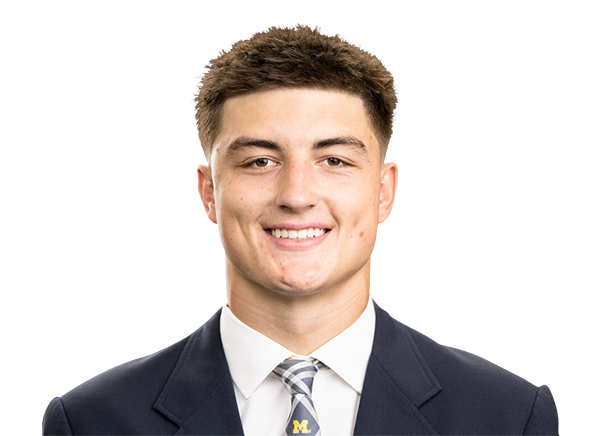
The skeptical case against Colston Loveland writes itself, and it is not unreasonable. He finished 2025 as TE12, a respectable but unspectacular 10.3 points per game across a full season. Chicago spent a Day 2 pick on Sam Roush, a traditional in-line tight end out of Stanford who projects as a blocking complement rather than a receiving threat, and added Hayden Large as undrafted depth behind him. Before Week 6 of this season, Loveland had caught just 13 passes for 110 yards, with lines as thin as one catch for three yards on three targets in Week 2. Two excellent games against Atlanta and New England are real, but two games is not a season, and plenty of tight ends have strung together a hot stretch tied to matchups or a short-term absence before settling back into TE2 territory.
That skepticism deserves a fair hearing before it gets answered. A Week 7 fantasy-market listing already had Loveland at an ADP of 71, which suggests the market has priced in some of this helium. The question is not whether Loveland is talented — he clearly is — but whether the conditions behind his last two weeks are durable enough to sustain a true top-five finish at the position, or whether this is a spike that regresses once the target distribution normalizes.
The Roush Pick and the Rest of Chicago's Target Pool
To understand what the consensus view is actually pricing in, start with what changed around Loveland this offseason. Chicago traded wide receiver D.J. Moore to Buffalo in March, along with a fifth-round pick, for a second-round selection — a trade that removed the single most significant target competitor from the receiver room. Veteran tight end Durham Smythe left in free agency for a one-year deal with Baltimore, clearing out depth-chart snaps at the position. The Bears did add competition: Sam Roush on Day 2 of the draft and Hayden Large as a college free agent, plus veteran receiver Kalif Raymond, who primarily competes for perimeter and return work rather than tight-end targets. None of those additions replaced the receiving volume Moore and Smythe left behind.
The more important continuity is at quarterback and play-caller. Caleb Williams remains the starter, and head coach Ben Johnson is entering his second season in charge with no coordinator change reported. That matters because Loveland's rapport with Williams is not a new variable he has to build from scratch — it is the same relationship that produced his 2025 target share, now operating with more vacated opportunity around it. On the depth chart beneath him, D'Andre Swift remains the lead back and Luther Burden III and Rome Odunze are Chicago's top two receivers, but neither receiver has established the kind of target lock that would cap Loveland's upside the way Moore's presence once did.
Twelve Targets on Thirty-Three Attempts
The strongest evidence against the hot-streak read is concentration, not volume alone. Against New England, Loveland drew 12 targets on just 33 Caleb Williams pass attempts — no other Bear had more than five. That is not a tight end benefiting from game script or a one-off matchup; that is a quarterback funneling more than a third of his throws to one player. The week before, against Atlanta, Loveland caught 6 of 7 targets for 65 yards and his first touchdown of the season. Across those two weeks combined, he totaled 13 receptions, 134 yards, and 2 touchdowns on 19 targets. A target share that concentrated, repeated in back-to-back weeks against different opponents, is harder to dismiss as noise than a single big box score would be.
Cole Kmet's Injury Removes the Competition
The clearest structural change arrived in the same Week 7 game that produced Loveland's second TE1 performance. Cole Kmet was carted off with what looked like a serious knee injury, and his absence — however the Bears manage it going forward — removes the one established tight end who had previously shared snaps and targets with Loveland. Sam Roush remains on the roster as a blocking-oriented complement, but the dossier does not support him as a receiving threat capable of reclaiming the volume Kmet's injury frees up. If Kmet is out for any real stretch, Loveland is positioned to inherit something close to every-down tight-end snaps in an offense that has already shown it will target him heavily.
Caleb Williams Is Saying It Out Loud
Quarterbacks do not always telegraph their intentions, but Williams has not been subtle about this one.
“It's just a matter of 'when.' He's Colston Loveland. He gets open, and he's going to keep getting open and I'm going to keep feeding him the ball.”
— Caleb Williams
That is a quarterback publicly committing to a usage pattern, not a coach's media-day platitude about effort and attitude. Combined with the target data from the prior two weeks, it reads less like a compliment and more like a stated game plan.
What Still Has to Go Right
The honest risks have not disappeared. Loveland's Week 7 line included drops, and it arrived in the same game Kmet got hurt, which makes it genuinely difficult to separate how much of that target total was earned role versus circumstance until Kmet's status is confirmed one way or another. If Kmet returns healthy and reclaims a significant receiving share, Loveland's target concentration likely cools toward something closer to his 2025 pace, which was good but not elite. The touchdown rate from these two games — two scores in two weeks — is also unlikely to hold at that pace over a full season; some regression there is close to certain. A true top-five finish needs the target share from New England to be closer to his floor than his ceiling, not a one-week outlier.
The Verdict on Loveland Going Forward
The 2025 baseline of a TE12 season is not nothing, but it was produced in an offense that still had D.J. Moore drawing targets and Cole Kmet sharing the tight-end room. Both of those conditions have changed in Loveland's favor. The evidence from the last two weeks — a 12-target game, a touchdown in consecutive outings, and a quarterback publicly committing to feed him the ball — supports a career-best season, not merely a hot stretch. Given the residual uncertainty around Kmet's health and the near-certainty of some touchdown regression, a top-five finish is the ceiling rather than the expectation. The more defensible call is a top-eight finish with legitimate week-to-week top-five upside, which is still a significant step up from last year's TE12 production and makes Loveland a buy for managers who do not already roster him.