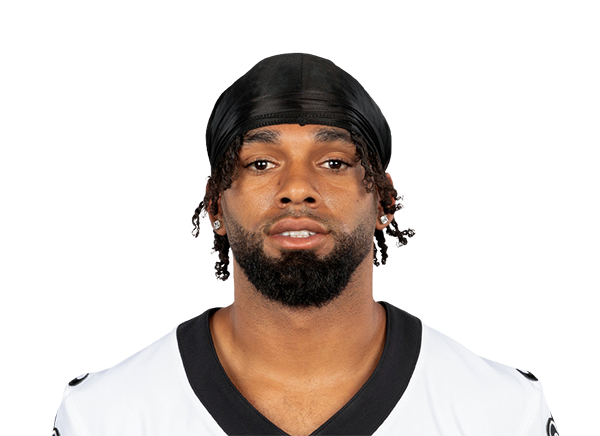
Chris Olave finishes 2026 as a top-12 PPR wide receiver. That is the claim, and it is not a leap of faith so much as a bet that the version of Olave who produced 100 catches for 1,163 yards and nine touchdowns in 2025 was operating in a worse situation than the one he enters this season. The market has him going in the mid rounds, roughly WR11 to WR14 and around pick 25 to 32 overall depending on the platform. That price reflects real caution about touchdown efficiency and health. It does not yet fully reflect the fact that New Orleans just handed him a four-year, $124 million extension and built its passing offense around him.
The case for buying in now, before the price catches up, rests on three things changing at once: the coaching staff, the quarterback, and the money. Each of those is new since last season. None of them was true when Olave was drafted as a rookie-year phenom in 2022, and none of them was fully true in 2025 either.
The Situation Now
Start with the depth chart, because that is where fantasy value actually gets decided. Olave is listed as the Saints' top left wideout, ahead of Bryce Lance and Kevin Austin Jr. at that spot, and camp reporting has consistently placed him ahead of Devaughn Vele in the receiver pecking order. That is a clean WR1 role on paper. The complication is the rookie class New Orleans added around him. Jordyn Tyson, the team's first-round pick at No. 8 overall, is the clearest new competition for targets, and the Saints also brought in Bryce Lance and Barion Brown as part of the same rookie receiver haul. Tyson's hamstring injury has been a notable subplot in camp, which limits his snaps for now but does not erase the long-term target competition he represents once healthy. On the other side of the ledger, the Saints lost Rashid Shaheed, along with Dante Pettis and Samori Toure, all listed among the team's offseason departures. That is real vacated volume, and Shaheed in particular was a field-stretching complement who is no longer around to siphon deep targets.
The bigger change is at quarterback and play-caller. Tyler Shough is expected to be New Orleans' starting quarterback in 2026, a shift from a 2025 season in which the offense was not built around him. Kellen Moore now runs the offense as head coach, and that represents a real change in offensive direction from what Olave played in last year. The other names on the depth chart matter mostly as context for how concentrated the passing game is. Travis Etienne Jr. leads the backfield but is not a heavy receiving-down threat that would meaningfully cut into Olave's targets. Juwan Johnson is New Orleans' starting tight end, but the position has not historically pulled a large enough target share in this passing game to change the math on Olave's workload. None of the pieces below Olave at receiver, quarterback, or tight end look built to take the ball out of his hands. The question is whether Shough and Moore can be efficient enough with it once it gets there.
The Evidence Case
Target Share That Survived a Bad Situation
Olave posted a 27.6% target share and a 39.4% air-yards share in 2025. That is elite volume, and it came in an offense that was not yet built around the quarterback now entering 2026. If Shough and Moore represent even a modest efficiency upgrade over last year's setup, that target share does not need to grow to produce a better statistical season. It just needs to convert at a higher rate. A Saints fantasy preview published in August captured the situation plainly.
“If Shough takes a legitimate step forward, Olave has a very realistic path to another 1,100+ yards and double-digit touchdowns.”
— Saints fantasy preview, Aug. 17
The Contract Is a Role Guarantee
Olave signed his extension on July 30, 2026, which matters for reasons beyond his bank account. Teams do not commit that kind of guaranteed money to a receiver they intend to split targets three ways. The deal is the clearest non-statistical evidence available that New Orleans views Olave as the offense's focal point through the transition to Moore and Shough, not a rental piece playing out a contract year. A Saints beat report from the same week put it directly.
“will shoulder the brunt of the workload for Moore's offense”
— Saints beat report, Aug. 17
Departed Competition, Arriving Competition That Isn't Ready Yet
Shaheed, Pettis, and Toure are gone, and those were real snaps and targets that have to go somewhere. Tyson is the long-term threat to Olave's target share, but a hamstring injury has slowed his path into the lineup, and recent joint-practice coverage described a rookie, Bryce Lance, filling in as the functional WR2 in the absence of veterans rather than Tyson himself. That is a favorable near-term mix for Olave: less proven competition subtracted, a first-round competitor not yet fully online.
The Counter-Argument
The honest case against this claim does not center on Olave's role, which looks secure. It centers on whether the Saints' offense can generate enough scoring for a WR1 target share to translate into a top-12 finish. Olave sat out the team's preseason opener and was an observer rather than a full participant during a stretch of joint practices, which keeps his durability profile in the conversation even though no current report removes him from the starting lineup. More importantly, a receiver's target share is only as valuable as the offense around it, and a new head coach paired with a quarterback making his first extended run as a starter is not a guaranteed efficiency upgrade. Two different projection sources for Olave's 2025 fantasy output conflict with each other, which is itself a sign that his weekly production has been genuinely volatile, not just target-driven and steady. A reasonable skeptic would argue that Olave's 2025 volume already represents his ceiling, and that touchdown scoring, which is the more fragile part of any receiver's stat line, is exactly the part most dependent on an unproven offensive system finding its footing.
That risk is real, but it is already priced into his mid-round cost. Nobody drafting Olave at pick 25 to 32 is paying for a top-five outcome. They are paying for a floor built on target share and a coaching and personnel change that removes some of what dragged the 2025 offense down. The bar for justifying that price is not elite touchdown efficiency, just competence, and competence is a lower threshold than the skeptic's case implies.
The Verdict
Chris Olave finishes 2026 as a top-12 PPR receiver because the pieces around him changed in his favor even as the pieces above him at receiver stayed manageable. Shaheed's departure removes proven competition. Tyson's rookie status and hamstring injury delay the ready-made threat to his target share. Shough and Moore represent a new offensive infrastructure that, at minimum, is not the same system that capped his touchdown efficiency last year, and the extension confirms the front office is building around him rather than shopping him. Draft him where the market has him, in the mid rounds as a high-floor WR1 or low-end WR2, and do not be surprised if the weekly-scoring picture looks more like his rookie-year hype than his most recent injury-shortened seasons.