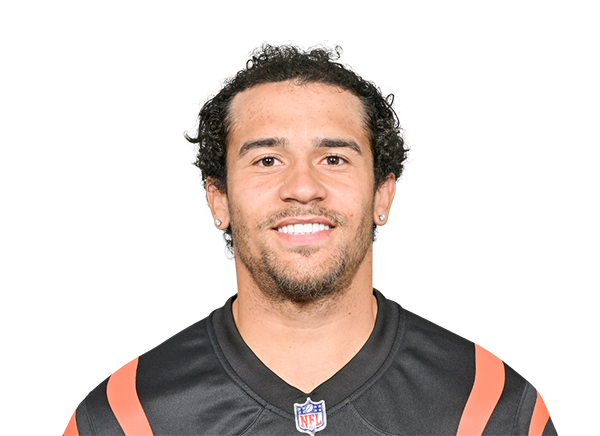
Chase Brown's role and receiving usage support an RB4-to-RB6 outcome in 2026, and that is not what a second-round, RB8-to-RB10 ADP is pricing in. The gap matters right now because drafts are happening this month, and the market has settled on a valuation that treats Brown as a solid, unspectacular RB1 rather than the workhorse-with-passing-game profile his 2025 season actually produced.
This is not a case of chasing last year's box score. Brown's situation in Cincinnati is essentially unchanged heading into his age-26 season, which is precisely the point: the conditions that produced a top-ten fantasy running back finish in 2024 and a top-seven finish in 2025 are still in place. When the underlying job doesn't change but the price does, that's a mispricing worth naming directly.
Perine, Brooks, and a Backfield That Never Changed
The clearest sign that Brown's role is stable is what didn't happen this offseason. There were no departures from Cincinnati's 2025 backfield that pulled meaningful touches away from him, and the core group returns largely intact: Samaje Perine, Tahj Brooks, Gary Brightwell, and Kendall Milton are all back behind Brown on the depth chart. Brooks, a 2025 draft pick, was Brown's backup entering the 2026 preseason, but nothing in his usage suggests he's positioned to siphon lead-back work. The Bengals also added undrafted free agent Jamal Haynes in April, but he's been described as a long shot for a roster spot, not a snap-share threat.
The bigger continuity story is at quarterback and play-caller. Joe Burrow is expected to start again in 2026, which is not a change from last season, and Dan Pitcher remains the offensive coordinator calling plays in a system built around Burrow's passing volume. Zac Taylor remains head coach. Joe Flacco sits behind Burrow on the depth chart as a veteran returner, but that's a insurance policy, not a scheme change. None of the pieces that funneled work to Brown in 2025 have been removed or replaced.
The Receiving Role That Makes Him More Than a Runner
Brown's fantasy case does not rest on rushing volume alone, which is why comparing him to committee backs undersells him. In 2025 he caught 69 passes, and PFF logged 86 targets on the season, a 21.5% target rate that places him firmly in receiving-back territory rather than early-down-only territory. That is the difference between a back whose value evaporates in negative game scripts and one who stays on the field regardless of score. PFF has gone further, describing Brown as the de facto third receiving option in Cincinnati's offense, which is a notable distinction in a passing attack built around Joe Burrow and Ja'Marr Chase.
What 19 Touches a Game Under Burrow Actually Means
The strongest recency signal in the dossier isn't a season total, it's a stretch. After Burrow returned from injury in Week 13 of last season, Brown averaged just over 19 touches and just under 20 fantasy points per game. That window is the cleanest available look at what Cincinnati's offense does with Brown when Burrow is healthy and the passing attack is fully operational, and it lines up with the season-long numbers: 232 carries for 1,019 rushing yards and 6 rushing touchdowns, plus 5 receiving touchdowns on top of the 69 catches. PFF ranked that a seventh-best fantasy points-per-game finish among running backs in 2025, up from tenth in 2024 on a similar workload of 229 carries and 990 rushing yards. The workload didn't spike due to an injury-created opportunity that could evaporate; it grew steadily inside a stable role.
“has top-five upside" and is "the de facto third receiving option in one of the league's most high-powered offenses”
— PFF
Where the Market Still Undersells Him
Consensus ADP has Brown going in the RB8-to-RB10 range, clustered around pick 2.01 to 2.08, or roughly 13th to 16th overall in PPR formats. There has been some recent upward movement, about a spot or so, which suggests drafters are starting to notice the profile. But a one-spot bump is not the same as pricing in a top-five outcome. PFF's own writing captures the gap: one piece stated there is little reason to expect a significant change in Brown's role for 2026, which is exactly the kind of role stability that should compress the difference between his price and a true workhorse's price, and it hasn't yet.
“cost-effective running back option”
— Ian Hartitz
Hartitz placed Brown at an RB4 ADP framing, which is a more aggressive read than the market's current RB8-to-RB10 clustering. The disagreement between that framing and the consensus price is the mispricing in miniature: some evaluators are already treating Brown's role as top-five caliber, while the broader draft market is still discounting him as merely a good RB1.
The Touchdown Equity Objection
The honest counter-argument is about touchdown equity, not role. Top-five running back seasons typically require either a dominant rushing-touchdown share or receiving touchdowns that outkick target volume, and Brown's production has leaned on Cincinnati's overall scoring environment as much as any individual touchdown monopoly. If Cincinnati's passing distribution shifts even modestly, or if short-yardage work drifts toward another back on the depth chart, Brown's ceiling compresses toward a very good RB1 rather than a league-winning one. That is a real risk, and it's the reason his price hasn't fully caught up to the role-based case for him.
But that risk is speculative, while the role stability is documented. Nothing in the offseason record, no free-agent addition, no coordinator change, no reported shift in touchdown-vicinity usage, points to Brown losing the receiving work or the early-down job that produced back-to-back top-ten fantasy finishes. Betting against a specific negative outcome that hasn't shown up in the evidence is a weaker position than betting on a role that has been stable for two straight seasons and is set to run through a third.
For fantasy managers, the practical takeaway is straightforward: Brown does not need a new role to justify a higher price, he needs the market to stop discounting the one he already has. Anyone drafting in the range where Brown is currently going should treat him as a value relative to the field, not just a safe floor play, and anyone picking earlier should not be shy about reaching a few slots to secure the receiving-back profile before the rest of the market catches on.