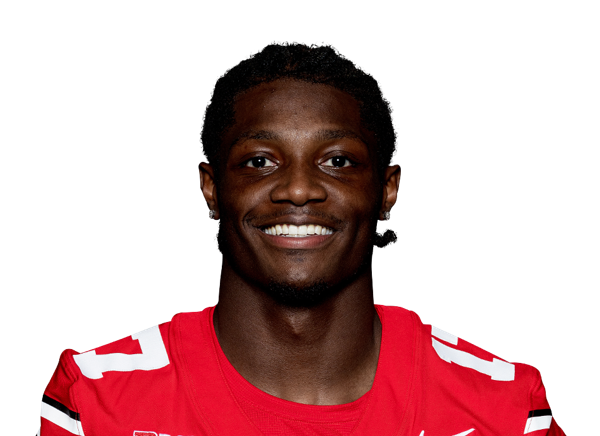
Carnell Tate is a confident WR3/FLEX start in Week 5 against Houston, and the role underneath that matchup — not the matchup alone — is why he belongs in lineups beyond a single week. The evidence for a soft four-game stretch is incomplete, but the evidence for a featured role in Tennessee's passing game is not. That distinction matters right now because Tate is coming off a 145-yard breakout and is dealing with a minor injury scare, which means managers have to decide this week whether they are starting a player or a trend line.
The claim worth making is narrower than top-12 across four weeks, because the full Weeks 6-8 opponent sequence has not been verified. What can be verified is that Houston entered Week 5 as the league's most generous defense against opposing receivers, and that Tate has become the first read on more than 40 percent of Titans targets over his last two games. That combination is a start, not a bench, and it is durable enough to matter past this single matchup.
Who Stands Between Tate and the Ball in Tennessee
Nearly everything around Tate changed this offseason except his quarterback. Cam Ward, Tennessee's first-round pick a year ago, returns as the starter entering his second season — the same arm, now throwing to a radically different receiver room. Robert Saleh arrived as head coach, and Brian Daboll came in as offensive coordinator and play-caller, bringing Wan'Dale Robinson and tight end Daniel Bellinger with him from New York. Robinson now competes with Tate for slot and underneath work, and Tennessee also signed veteran K.J. Osborn for rotational snaps. On paper, that is three bodies competing for targets in a passing game that didn't exist in this form last year.
None of that competition has stopped Tate from taking over the target tree. He was the fourth overall pick in April, signed to a four-year, roughly $51.13 million contract, and was never positioned as a complementary piece — Tennessee's stated plan was to hand Ward a true number-one option. Tony Pollard remains the early-down back and a check-down option out of the backfield, and Gunnar Helm is the starting tight end, but neither cuts meaningfully into what is clearly becoming a receiver-funneled passing offense. Robinson is the more real threat to Tate's ceiling, since he operates in the same underneath space, but Tate's first-read rate over Weeks 3-4 shows Daboll is building around him, not around the Giants import.
The Target Share Is Not a Fluke of One Big Game
The easy dismissal of Tate's breakout is that one huge game against Baltimore — nine catches, 145 yards, 12 targets — is doing all the lifting. The target-share data says otherwise. Over Weeks 3 and 4 combined, Tate drew 21 targets for 15 receptions and 203 yards, a 30.9% targets-per-route-run rate that ranked fourth among all receivers across that span. His 40.5% first-read share over the same two weeks ranked fifth leaguewide. That is not a product of garbage-time volume or a single flukey script; it is Daboll consistently looking for him first.
Through four games, Tate's 29.6% target share ranks sixth-highest in the league. A rookie carrying that kind of target load in his own offense, regardless of surrounding name value, is the profile fantasy managers chase every year — the difference here is that the profile showed up almost immediately, inside a brand-new coaching staff's first month of play-calling.
Houston Is the Only Matchup Actually Confirmed Soft
The schedule argument has to be made honestly. Houston entered Week 5 having allowed the most fantasy points to opposing receivers of any defense in the league, which is as clean a plus matchup as exists on a given week. That is real and it is why Tate is an easy Week 5 start. What is not available is a verified Weeks 6-8 opponent sequence, so any claim about a full four-week soft stretch would be reaching past what the data shows. The honest version of this claim is that Tate's role is strong enough to carry him through matchups that are merely average, and that Houston specifically is a matchup where his ceiling should show up.
The Back Tightness and the Small-Sample Objection
The strongest case against trusting any of this is twofold. First, there's the injury: Tate was limited in practice on Thursday and Friday and was officially listed as questionable for Week 5 with back tightness, even after head coach Robert Saleh said he was fine. Second, and more structurally important, is the sample-size concern — before the Weeks 3-4 surge, Tate had only 13 receptions for 123 yards across the first three weeks of the season. A two-game hot streak inside a four-game body of work is a legitimate reason to pump the brakes on declaring a rookie a locked-in WR1.
“Tate had some random tightness yesterday but is fine.”
— Robert Saleh, October 9, 2026
“Robert Saleh said Carnell Tate is good to go.”
— Robert Saleh, as reported by ESPN's Turron Davenport, October 9, 2026
Both concerns are fair, but neither undoes the case. The injury is a practice-limitation story with a coach publicly expecting him to play, not a structural absence. And the slow start over the first three weeks is better explained by a new coaching staff installing an offense than by Tate's talent or role being overstated — the target share and first-read numbers only improved as Daboll settled in, which is the opposite of a pattern that should worry anyone.
What To Do With Him This Week and Beyond
Start Tate in Week 5 against Houston without hesitation, assuming he clears the questionable tag, which Saleh's comments suggest he will. Beyond this week, treat him as a weekly must-start based on role rather than a schedule-driven streamer — the target share, the first-read usage, and the fact that Daboll's offense is clearly funneling targets his way matter more than any single opponent. The one caveat is to monitor the injury report closely in-season, since back tightness in a rookie carrying a heavy route count is worth tracking even when a team insists it is minor. Do not bench him for matchup reasons once the Weeks 6-8 schedule becomes known unless the data on those defenses is genuinely bad — the role he has built is too strong to override with modest matchup concerns.