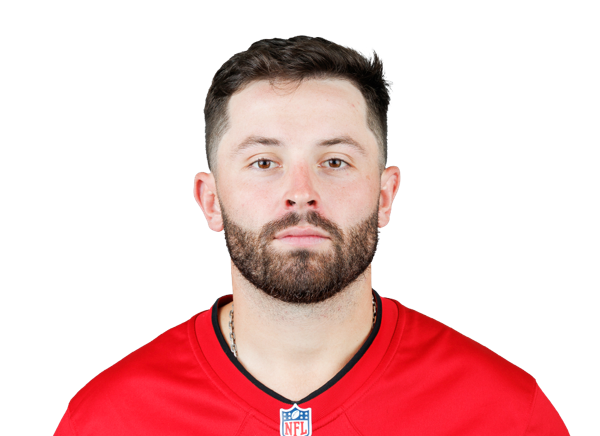
Baker Mayfield enters 2026 as the Buccaneers' unquestioned starter, and his 2024 season — QB3 in fantasy points per game — is the reason managers are still reaching for him in drafts. That one elite season is doing a lot of work. The case against him is not that he cannot produce at that level. It is that the evidence from 2025 points to a player whose efficiency has eroded, whose body absorbed a punishing injury load, and whose surrounding cast has not demonstrably improved. Draft capital spent on Mayfield at his current cost is draft capital misspent.
His current market sits at an ADP in the mid-to-late rounds depending on the format, with fantasy ranking sources pegging him around QB19 as recently as late July 2026. That places him in a range where managers are treating him as a borderline starter — a high-upside flier rather than a premium investment. The problem is that even at that price, the 2025 data argues he is more likely to finish outside the top-12 than inside it, and the structural reasons for that outcome have not gone away.
The Efficiency Drop Was Real and Severe
The single most important data point in this case is the gap between Mayfield's 2024 and 2025 efficiency numbers. His completion rate fell from 71.4 percent in 2024 to 63.2 percent in 2025. His yards per attempt dropped from 7.9 to 6.8. His passing yards fell from 4,500 to 3,693. His touchdown total dropped from 41 to 26. Every major passing efficiency marker moved in the wrong direction, and the cumulative drop pushed him from QB3 in fantasy points per game all the way to QB19.
A one-season efficiency dip of that magnitude is not noise. It is a signal. The question is whether the signal reflects temporary injury disruption or a more durable change in his game. Even in the most charitable reading — the one that attributes everything to the injury pile-up — the 2025 season still produced a QB19 finish. For a manager drafting him as a borderline top-15 option, that outcome is already the bust scenario.
The Injury Profile Is a Compounding Concern
Mayfield played through biceps, shoulder, knee, and oblique injuries in 2025, along with reported PCL, MCL, and bone bruise issues. That is not a minor injury report. That is a veteran quarterback absorbing contact across nearly every major joint and soft-tissue group in the body. He deserves credit for staying on the field — and his proponents will cite that durability as evidence of toughness. But there is a difference between staying on the field and playing at full capacity, and the 2025 efficiency numbers make clear that the injuries were degrading his output even as he continued to start.
A full offseason of recovery may restore some of that baseline. The Buccaneers' own season preview frames 2026 as a recovery-and-rebound year. But a quarterback who absorbed that volume of injury stress in 2025 enters 2026 with a real durability question mark, not a clean bill of health. If he misses games or plays through another mid-season breakdown, the fantasy floor is low. There is no receiving back capable of sustaining value the way a healthy Mayfield can.
The QB Market Has Caught Up and Then Some
The deeper problem for Mayfield's 2026 draft value is not just what he did in 2025 — it is what the rest of the quarterback market looks like. Lamar Jackson and Josh Allen occupy a tier of their own. Joe Burrow, coming off a strong 2025 despite missing nine games, returns with a healthy full season as the expectation. Drake Maye and Sam Darnold both delivered in 2025 and enter 2026 with momentum. Jayden Daniels, Jalen Hurts, and Patrick Mahomes round out a group of quarterbacks whose fantasy floors are more reliably above the QB12 threshold than Mayfield's.
Then there is the second tier. Cam Ward enters 2026 with a full offseason as the unquestioned Tennessee starter after a rookie year finding his footing — the year-two quarterback leap is one of fantasy's most reliable patterns. Bo Nix brings a rushing floor from a scheme built around his legs. Kyler Murray in Minnesota is a new situation worth monitoring. By the time you reach Mayfield at his ADP, you are paying for a player who needs to beat a realistic QB12 threshold in a market where at least a dozen quarterbacks have a more credible path to that finish.
The Counter-Argument: Injuries Explain Everything
The honest steelman here is straightforward: Mayfield played 2025 on one leg, essentially. The injury list — biceps, shoulder, knee, oblique, PCL, MCL, bone bruise — is the kind of accumulation that would degrade any starting quarterback's numbers. The 2024 version of Mayfield was a legitimate fantasy QB1, finishing QB3 in points per game. If he enters 2026 healthy, and if the Buccaneers' offensive roster recovers around him, a bounce-back to something close to that 2024 baseline is not an unreasonable projection. He also added a career-high in rushing yards in 2025, leading quarterbacks in yards per rush, which means his rushing floor remained intact even through the injury fog. That is a meaningful fantasy floor.
The answer to the steelman is this: even if you grant full injury explanation for 2025, you are still left with a player who needs a best-case health outcome and a best-case offensive environment to reach a top-12 finish. That is not a profile worth paying for in the middle rounds. The bust risk is not that he finishes as a bottom-tier starter — it is that he finishes exactly where he finished in 2025, as a QB19, while managers who drafted him had reasonable top-12 expectations. In a deep quarterback market, the opportunity cost of that miss is significant. Managers who take him as their primary starter are likely to spend a waiver priority or a streaming week recovering from a shortfall they could have avoided at the draft table.
There is also no sourced evidence of a major schematic overhaul or a significant new weapon added to the Tampa Bay offense. The Buccaneers' framing of 2026 as a rebound year is aspirational, not structural. The passing offense is still built around Mayfield as the primary engine, but aspirational framing from a team preview is not the same as a concrete plan to fix the efficiency problems that drove the 2025 collapse.
The Verdict
Baker Mayfield is a viable starting quarterback for the Tampa Bay Buccaneers. He is not a viable fantasy asset at the cost his 2024 reputation commands. His 2025 season produced a QB19 finish driven by severe injuries, cratering efficiency across every major passing metric, and a late-season fade that the Buccaneers' own preview acknowledges. He enters 2026 with a recovering body, no documented schematic upgrade, and a quarterback market that offers more reliable top-12 options at comparable or cheaper draft prices.
The claim here is that Mayfield finishes outside the top-12 at quarterback in 2026 despite being drafted as a borderline top-15 option. The path to that outcome is not exotic — it is simply a repeat of 2025, which is the most recently available evidence on record. In a format where a missed quarterback can cost a manager weeks of roster stress, that risk profile does not justify the investment. Draft behind him in a two-QB league if you need the depth. In single-QB formats, spend the pick elsewhere.