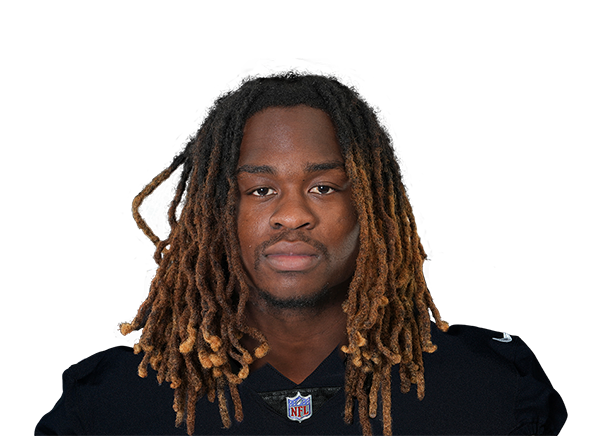
The thing that changed for Ashton Jeanty this offseason is not his job description. It is everything around it. He enters year two as the same lead back he was as a rookie, but the roster and scheme surrounding him have been rebuilt in ways that should make his workload more efficient even if the raw touch count looks similar. That is a quieter story than a training-camp battle, but it is the more important one.
Head coach Klint Kubiak, hired in February 2026, has said publicly the Raiders are counting on Jeanty for Week 1, and has repeatedly framed him as the lead back even while managing his injury situation day to day. That is not a coach hedging about a job battle. It is a coach protecting his best offensive weapon.
What His Rookie Year Actually Proved
Jeanty's rookie season established him as the Raiders' clear featured back, and the market never really stopped believing in him. Before this month's injury news, he was going off the board around overall ADP 11, an RB6-level price, which tells you the fantasy market had already priced him as a locked-in workhorse rather than a timeshare piece. That valuation was built on year one usage.
The audit worth doing is not whether Jeanty was good as a rookie. It is whether the conditions that produced that usage still hold. The quarterback does not hold — the Raiders are turning to rookie Fernando Mendoza in 2026, a real change from last season. The play-caller does not hold — Kubiak is new, and so is offensive coordinator Andrew Janocko, hired the same month. Two of the three variables that shaped Jeanty's rookie-year role are gone. The one variable that does hold is the job itself: he is still RB1 on the depth chart, and the team is still building around him rather than away from him.
The Pieces Kubiak Added Around Him
Two additions matter here, and they cut in Jeanty's favor rather than against him. Center Tyler Linderbaum arrives to improve the interior run blocking directly in front of him, which is the kind of unglamorous investment teams make when they intend to run the ball through one back rather than spread touches around. Rookie running back Mike Washington Jr. was also drafted this year, and he will compete for relief snaps and change-of-pace work, but nothing in the available reporting suggests he is positioned to challenge Jeanty for the early-down or passing-down role. He is a depth piece, not a threat to the job.
On the passing side, the offense still funnels through tight end Brock Bowers, who remains the clear top receiving option in this offense. That matters for Jeanty less as a target competitor and more as a signal: with a rookie quarterback under center, an efficient run-first approach that leans on Jeanty and Bowers is the offense's likeliest identity, not a pass-heavy scheme that would dilute his touches.
What a Rookie Quarterback Means for the Running Game
Rookie quarterbacks tend to lean on the run game, both by scheme design and by circumstance — offensive staffs protect first-year passers by controlling the ball on the ground and shortening the game. Mendoza starting under Kubiak, a coach whose track record leans run-oriented, points toward exactly that kind of structure. If that holds, Jeanty is positioned to see early-down volume that does not evaporate even on weeks the passing game struggles, which is the profile that produces weekly RB1 floors rather than boom-or-bust output tied to game script.
The Case Against Him, and Why It Is Not Disqualifying
The honest counter-argument is that none of this matters if the ankle sprain from Aug. 23 lingers. Kubiak has repeatedly declined to detail the injury beyond saying Jeanty is on the mend, and as of Aug. 28 there is still real uncertainty about Week 1 status. The sprain has been described as more low than high and not considered major, which is a meaningfully better outcome than a high-ankle sprain would be, but it is not nothing for a back whose value depends on early-season rhythm and workload.
That argument is worth taking seriously, and it is the reason a projection built purely on talent and scheme fit would be incomplete. But it is an argument about timing, not about the job itself. There is no indication in any recent report that Washington Jr. or anyone else is being positioned to take over the role if Jeanty is slowed early. The team's own language — counting on him, still on the mend, not a long-term issue — describes a player they expect to have, not one they are moving on from.
The Call
Jeanty was already being drafted as an RB6-caliber asset before any of this offseason context was fully priced in. Strip away the injury noise and the underlying trend is positive: better interior blocking, a coaching staff that talks about him as a focal point rather than a piece of a rotation, and a passing structure likely to lean on the run because of the rookie quarterback under center. None of the backfield additions represent a real threat to his snaps. The role is not just intact — the environment around it has improved.
The practical move is to treat any injury-driven price dip as a buying window rather than a red flag on the role itself. Draft Jeanty as a locked-in lead back with borderline top-10 upside, and downgrade Washington Jr. to a late-round injury-insurance flier at best. The job was never really in question. The supporting cast around it is what changed, and it changed for the better.