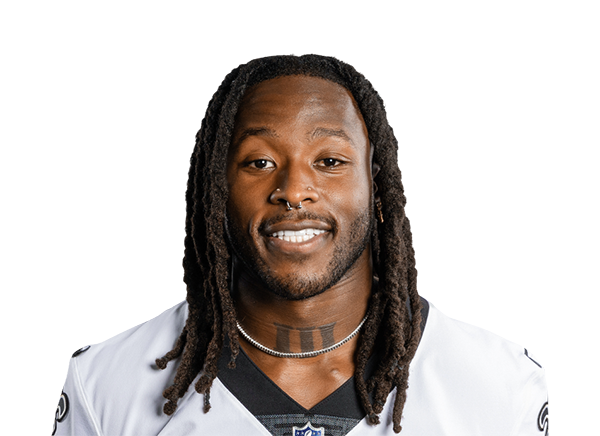
Alvin Kamara scored two touchdowns in Week 10 against Carolina. He also touched the ball five times, played on roughly a quarter of New Orleans' offensive snaps, and gained 14 total yards. One of those facts is driving his price this week. The other is the actual report on his role, and it says Kamara is no longer the engine of this offense — he is a situational piece who happened to find the end zone twice in a game where he barely played.
That gap matters right now because managers are reacting to the box score, not the usage. One early Week 11 ranking update had Kamara as a top-six running back off the strength of the touchdowns. Another flex-spot ranking the same week had him 106th overall. That spread is not noise — it is the market trying to decide whether to believe five touches and two scores, or a season of declining snap counts. The evidence says believe the snap counts.
The Etienne-Estime Rotation Running New Orleans' Backfield
New Orleans signed Travis Etienne Jr. to a three-year contract this offseason, explicitly as a featured back, and added Audric Estime the same offseason to compete for short-yardage and rotational work. Those two additions, not a single new acquisition, are the reason Kamara's workload has shrunk. Etienne returned from a hamstring-related absence in Week 10 and the result was not Kamara reclaiming lead-back touches — it was a true three-man rotation. In that Carolina game, Etienne logged 11 touches and played 34.4% of snaps, Estime had eight touches on 44.3% of snaps, and Kamara had five touches on roughly a quarter of the offense's plays. New Orleans has since elevated Zamir White as additional in-season depth, which only adds more competition for carries rather than less.
The passing game runs through Tyler Shough at quarterback, with Kellen Moore calling plays as head coach and Doug Nussmeier serving as offensive coordinator. Nothing in the available reporting suggests this staff has committed to funneling the backfield through Kamara specifically. The offense is built around a three-back distribution by design, not around one player who happens to average nine-plus years of wear on his legs.
Kamara's Receiving Volume Is the Real Argument for Paying Up
The strongest case for staying in on Kamara is not the touchdowns — it is the target share. Through Week 10, Kamara caught 28 passes on 35 targets, a conversion rate that signals he remains a trusted check-down and screen option even as his carry total erodes. In a three-man committee where early-down work is split three ways, receiving work is the most stable form of touches, because it does not require Moore and Nussmeier to choose him over Etienne or Estime on early downs — it requires only that Shough look his way out of the backfield. That role alone keeps Kamara fantasy-relevant in PPR formats even on weeks when the ground game goes elsewhere.
The Red-Zone Case: Touchdowns Still Count
The second argument is simpler and harder to dismiss outright: touchdowns are real points regardless of how they are earned. Kamara has five touchdowns in eight games — three rushing, two receiving — and the Week 10 game proved he can still be deployed as a short-yardage and goal-line weapon even on a 16-snap workload. If New Orleans continues to lean on him in scoring range while Etienne and Estime handle the between-the-20s grind, Kamara could keep producing touchdown-driven weeks that outperform his touch count. A bench flex who scores is still a usable bench flex.
Why the Touchdown Rate Won't Hold
The honest counter-argument is that touchdown-dependent backs can be started profitably for stretches, and dismissing Kamara entirely risks fading a player who just produced a two-score week. That argument has some force. But it rests on treating the Carolina game as a signal rather than an outlier, and the surrounding numbers argue against that read. Kamara's snap share fell from 56% in Week 7 to 49% in Week 9 to roughly a quarter of the offense in Week 10 — a trend line pointing one direction. His season-long rushing efficiency is 3.3 yards per carry on 49 attempts, which is weak enough that the Saints have no incentive to hand him a larger early-down role even if they wanted to. And Etienne's return, not an injury or a one-week game plan, is the structural reason Kamara's workload shrank. That is a permanent condition of this backfield, not a temporary dip that corrects itself once Carolina is off the schedule.
The Trade and Lineup Call on Kamara
The tiebreaker here is usage, not touchdowns, because touchdown rate regresses and snap share does not lie about intent. New Orleans added Etienne as a featured back and Estime as a rotational piece this offseason, then elevated Zamir White for further depth — every roster move this year has diluted Kamara's workload, not concentrated it. A player in a three-man committee who cannot crack even a third of the snaps is not a weekly must-start regardless of how the touchdowns land in any single game.
The actionable move is to treat the Carolina game as the moment to sell, not to buy. If a trade partner is offering value based on the two-touchdown line, take it — that price will not look as good in three weeks once the sample includes more low-touch outings. Game managers should rank Kamara as a touchdown-dependent flex rather than a locked-in RB2, start him only in matchups where New Orleans is expected to be in scoring range often, and prioritize Etienne and Estime in season-long roster value conversations, since the workload trend favors both of them over Kamara going forward.