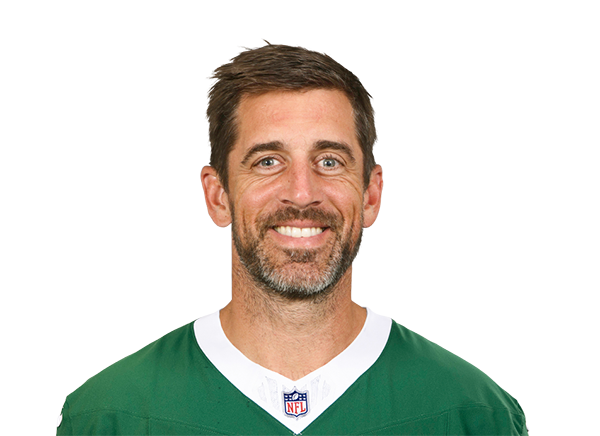
Aaron Rodgers' claim on fantasy rosters right now rests on three straight games with exactly three passing touchdowns. That is the entire case for him as a weekly starter. The deeper numbers underneath that stretch — modest yardage, no rushing floor, and a touchdown rate that has no precedent for holding — say this is a streak, not a new level. The claim here is simple: Rodgers finishes the rest of 2026 as a matchup-dependent streaming QB2, not a rest-of-season top-12 quarterback, and the moment to move him in trade is before the next bad week makes that obvious to everyone else.
This matters now because the hot stretch is exactly the kind of small sample that inflates a waiver-wire price. Rodgers was rostered in just 19.3% of leagues as of October 13, with a suggested 2% FAAB bid attached — the market is treating him as a cheap streamer, not a locked-in starter. That valuation is more honest than the raw touchdown total suggests, and it is the valuation a fantasy manager should trust when deciding whether to hold, start, or trade him.
Mike McCarthy, DK Metcalf, and a Redrawn Pittsburgh Passing Room
The offense around Rodgers changed meaningfully this offseason, even though his QB1 depth-chart spot did not. Mike McCarthy took over as head coach in January 2026, replacing Mike Tomlin — notable mostly because McCarthy coached Rodgers for 13 seasons in Green Bay, which argues for continuity in how Rodgers is used, not for a sudden spike in ceiling. No new offensive coordinator has been confirmed, so the scheme details beyond a pass-heavy neutral-situation approach remain unclear.
The receiving room looks different. DK Metcalf arrived in a March 2026 trade as a major new receiving-target addition, and Michael Pittman Jr. came over from Indianapolis to compete for starting wide receiver targets as well. George Pickens, meanwhile, was traded away in May 2026, leaving his targets to be redistributed — largely to Metcalf and Pittman. At running back, Jaylen Warren remains the primary back with free-agent addition Rico Dowdle behind him, though that competition is mostly about backfield touches between Warren and Dowdle rather than a direct factor in Rodgers' passing role. Behind Rodgers at quarterback, Mason Rudolph, Will Howard, and rookie Drew Allar add organizational depth but pose no threat to his starting job this season.
The net effect: Rodgers now throws to a retooled group led by Metcalf and Pittman rather than Pickens, with largely the same coach-player chemistry from the McCarthy era in Green Bay but no confirmed new playcaller to credit for a scheme leap. That is a lateral change in talent, not an obvious upgrade that explains a three-touchdown-per-game pace.
Nine Touchdowns in Three Weeks, Six Rushing Yards in the Latest One
The surge itself is narrow and specific. Across weeks 3 through 5, Rodgers threw for 826 yards, nine touchdowns, and three interceptions — an average of 275.3 passing yards per game, which is solid but unspectacular. The fantasy points came almost entirely from touchdown concentration: 28.68, 27.96, and 28.0 points in those three games, built on exactly three passing touchdowns each time. That is as clean a signal of touchdown-rate dependence as a sample can produce.
Week 5 is the clearest window into what happens when the touchdowns regress even slightly. Rodgers posted his best completion rate of the season at 71.0%, yet produced only 235 passing yards and six rushing yards. Efficiency without volume or touchdowns is a modest fantasy week, not a top-12 week. Through five games overall, his touchdown-to-interception ratio sits at 10:4 — a strong mark, but one still anchored by that same three-game stretch rather than a full-season trend. Strip out the touchdown spike and the underlying profile is a 42-year-old pocket passer with no rushing production to fall back on in a quiet game.
DK Metcalf and Michael Pittman Jr. Split the Looks That Used to Go to One Player
Touchdown streaks in modern passing offenses often ride on one or two hot red-zone connections. Pittsburgh does not have that single go-to target anymore. Metcalf arrived as the marquee receiving addition, and Pittman was brought in separately to compete for starting targets, with both now absorbing the share that George Pickens left behind after his May trade. That means Rodgers' passing-touchdown production this season is being split across a retooled receiving corps rather than concentrated through one established chemistry partner the way a true touchdown-dependent QB1 usually needs.
That split cuts against the sustainability of a three-touchdowns-per-game pace. A receiving room still sorting out roles between two new additions is more likely to produce uneven, boom-or-bust touchdown distribution than a repeatable weekly total. If Metcalf or Pittman cools, or if the touchdown work shifts toward the run game, Rodgers has no rushing floor of his own to cushion the loss — his six rushing yards in Week 5 underline that he is a pure pocket passer at this stage of his career.
The Fourth-Ranked Pass Rate Is the Honest Counter-Argument
The strongest case against this regression thesis is volume, not touchdowns. Pittsburgh entered Week 6 fourth in the league in neutral-situation pass rate at 60.0%, and Rodgers has attempted at least 35 passes in four of his first five games. A quarterback throwing that often can stay fantasy-relevant purely on yardage and garbage-time opportunity even if his touchdown rate falls back toward a more typical two-per-game pace. That is a real and reasonable objection, and it is the main reason Rodgers is worth owning at all.
But volume alone did not produce his three-game surge — nine touchdowns in three games did, against only 275.3 yards per game. Volume supports a streaming floor, not a top-12 ceiling. That is consistent with how the market is already pricing him: a low-end starter designation ahead of a Week 6 matchup at Tampa Bay, with New Orleans and Cleveland following before Pittsburgh's Week 7-9 bye. Those are matchup-dependent spot-start calls, not season-long must-starts, and they line up with a 19.3%-rostered, 2%-FAAB valuation far more than with a top-12 arc.
What Fantasy Managers Should Actually Do With Rodgers Now
Rodgers is also worth framing honestly as a short-term asset. He has reportedly said he plans to retire after the 2026 season, which does not change this week's lineup decision but reinforces that there is no long-term equity to protect here — only a current-season window to extract value from. For a manager who added him off waivers during the hot streak, this is the moment to see if a touchdown-points-driven image still has trade value, because that image will not survive a quiet week against a tougher defense.
The practical plan: start Rodgers in favorable matchups where Pittsburgh's pass-heavy tendencies and Metcalf's or Pittman's target shares project well, bench him against stout defenses, and do not count on him as a locked-in weekly QB1. He is a streaming QB2 with a real floor built on volume, not a top-12 finisher built on a touchdown rate that has already shown signs of running hotter than the underlying yardage supports.